
Raising Their Voices in Song
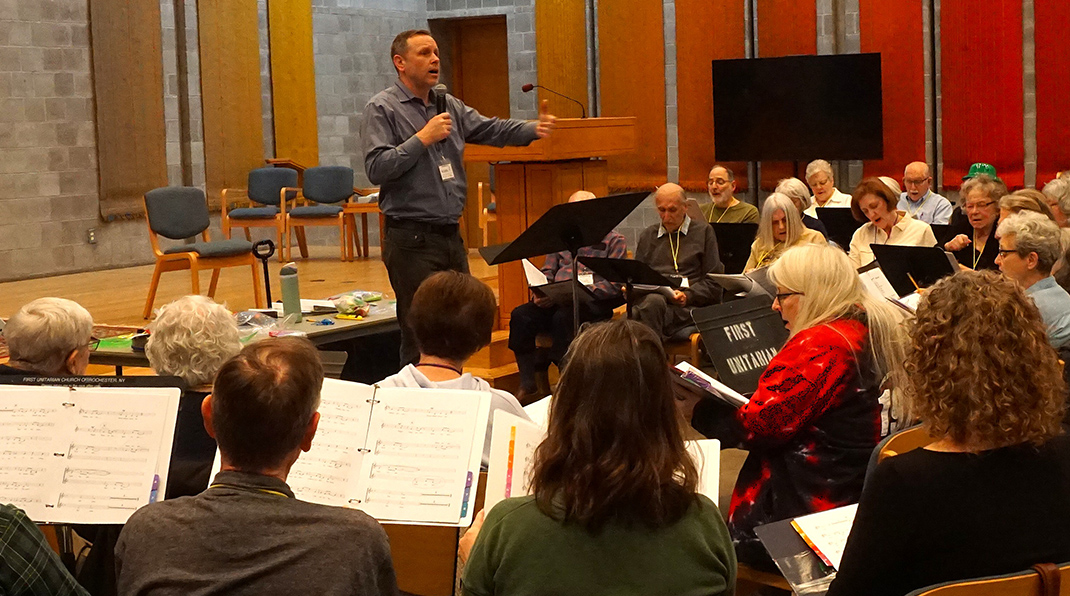
ENCORE Chorus members — adults who have early- to middle-stage Alzheimer’s or related dementias, their caregivers and the volunteers — enjoy getting together to sing
By Mike Costanza
Dan Schuster looks forward to the Mondays when he can sing with the ENCORE Chorus, particularly when it does Beatles tunes.
“The Beatles are my favorite group that ever lived and I just love hearing any of their songs.” the 78-year-old Rochester resident said.
ENCORE, which stands for “Every New Connection Offers Resonating Experiences,” also brings Schuster and his wife of 32 years, Terry, together with people with whom they have something in common.
The chorus’ membership consists of adults who have early to middle-stage Alzheimer’s or related dementias, their caregivers and the volunteers who help them participate in the group. Schuster has early-stage Alzheimer’s disease and his wife is his caregiver.
Alzheimer’s is a degenerative disease that results when cell damage brings about complex changes in the brain. It typically attacks the part of the brain associated with learning first, so its most common early symptom is trouble remembering new information. The disease is the most common cause of dementia, an umbrella term for a group of symptoms that include memory loss, problems communicating, difficulties with reasoning or problem-solving and poor control of movements.
According to the Alzheimer’s Association’s 2026 Alzheimer’s Disease Facts and Figures report, 426,500 New York state residents aged 65 and older live with Alzheimer’s.
Michael Anderson, a professor of musicology at the Eastman School of Music, founded ENCORE in March 2024 after learning of a pilot study that was conducted in Arizona to determine whether live music affected the stress levels of those living with Alzheimer’s and their caregivers.
“I saw some outstanding results when members of the Phoenix Symphony played for advanced patients in long-term care facilities,” he said.
ENCORE is offered through the Eastman Community Music School, which is part of the University of Rochester’s prestigious Eastman School of Music. The chorus rehearses each Monday of a 12-week semester, then caps off its time with a formal concert.
Any adult who has Alzheimer’s or dementia can join; no one has to proffer a formal diagnosis to come and sing and many in the group who are suffering from the illnesses are older adults. ENCORE, which had just nine people when it started, now has close to 80 members.
ENCORE’s operations are guided by the Giving Voice Network, which advocates for the creation of independent, dementia-friendly choruses in every community. In keeping with that network’s guidance, most of the selections the chorus learns each semester are tunes its members find familiar and want to sing.

“I ask our participants for suggestions of songs that relate to a specific theme,” said Erica Porter Smith, the chorus’ music director, who has a Bachelor of Arts in music therapy and a Master of Science degree in creative arts therapy.
The familiar tunes are jumping-off points from which members are helped to stretch their minds, building new areas of thought and memory.
“It’s not just a matter of just remembering things, it’s actually building and showing that we can learn together,” Anderson said.
Members are also taught to sing new songs, thereby helping them continue growing, learning and expanding their musical abilities. None of the selections in ENCORE’s repertoire are very complex.
“We keep the vocal range or notes to a minimum, adjust the keys when needed and use or create arrangements that are one-two parts,” Smith said.
Some of the pieces the chorus performs don’t involve singing at all. During a rehearsal on March 16, the chorus sang the well-known Broadway hits “Getting to Know You” and “There’s No Business Like Show Business,” whistled “The Sound of Music” and played other songs on kazoos, small drums and tone chimes. At one point, Anderson danced to a tune on stage while members danced in place at their chairs.
“My goal with incorporating whistling, kazoos, movement and instruments is to provide opportunities to engage as many neural pathways as possible,” Smith said.
The chorus also rehearsed “Here We Are,” an original work by Eastman School of Music professor of music teaching and learning Philip Silvey. After rehearsing for about an hour, members broke up to spend time enjoying snacks and socializing.
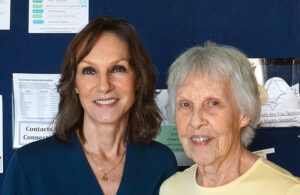
Kathy Grunow and her mother, 90-year-old Nancy Liperote, have been members of ENCORE since it started. Grunow, who is her mother’s caregiver, said she has early–onset dementia, is hearing impaired and is ”rather introverted,” but enjoys singing the vintage songs she loves. Pieces by the late crooner Jerry Vale are her favorites.
“She doesn’t have to struggle with learning new words or recalling new notes, rhythms, phrases, so she could be, I think, more in the moment and just capture the joy, the memories of that particular song,” the 64-year-old said. “It brings me a sense of hope that she’s still enjoying life and able to do some of the things that she loved doing as a younger person.”
The Schusters also share the joy of singing with ENCORE.
“We’re completely joyful on Monday morning; we’re over the moon while we’re here and this good feeling lasts well into the evening,” said 71-year-old Terry.
Even the volunteers who help pairs of Alzheimer’s and dementia sufferers participate in the chorus enjoy being in it. Retired music teacher Janice Peters has given her time to the chorus since it started and brought the tune chimes members played on March 16.
“I love to see these people sing,” the Penfield resident said. “They want to sing and it brings them joy.”
Peters also has personal reasons to volunteer for the chorus, having lost a brother-in-law and a very good friend to Alzheimer’s.
“They were both musical, as am I, and this is a nice way to give back,” she said.
Rose Lin, an assistant professor at the University of Rochester School of Nursing, said singing in choruses could benefit those suffering from Alzheimer’s and dementias in more material ways.
“Studies from the US, Ireland, Sweden and Australia suggest that participating in group singing can reduce agitation in people with dementia, improve their quality of life, and strengthen the emotional connection between caregivers and their loved ones,” she said.
Lin has studied a number of ENCORE members who have Alzheimer’s or dementia and their caregivers to determine whether participation in the chorus has benefited them. The members studied range in age from 62 to 92.
“Our hypothesis is that singing together creates brief but meaningful moments of shared joy—what we call ‘uplift’—and that these moments reduce caregiver stress and challenging dementia-related behaviors like apathy and agitation,” she said.
Preliminary results indicate that the choral program might be helping those who are raising their voices in song.
“Caregivers described the program as very meaningful, reporting that singing together lifted their spirits and gave them a sense of belonging and community,” Lin said. “They observed their loved ones becoming more engaged, less withdrawn, and more talkative, even continuing to reminisce about songs after sessions ended.”
Lin said the study’s preliminary findings strongly support the idea that group singing “creates the kind of uplifting shared experiences that can break the cycle of caregiver stress and dementia-related behavioral symptoms.”
Lin intends to continue examining the effects of ENCORE participation upon chorus members and said that the data gained could be used to improve the program’s design.
For more information on the group, go to: www.esm.rochester.edu/community/course/encore-chorus