
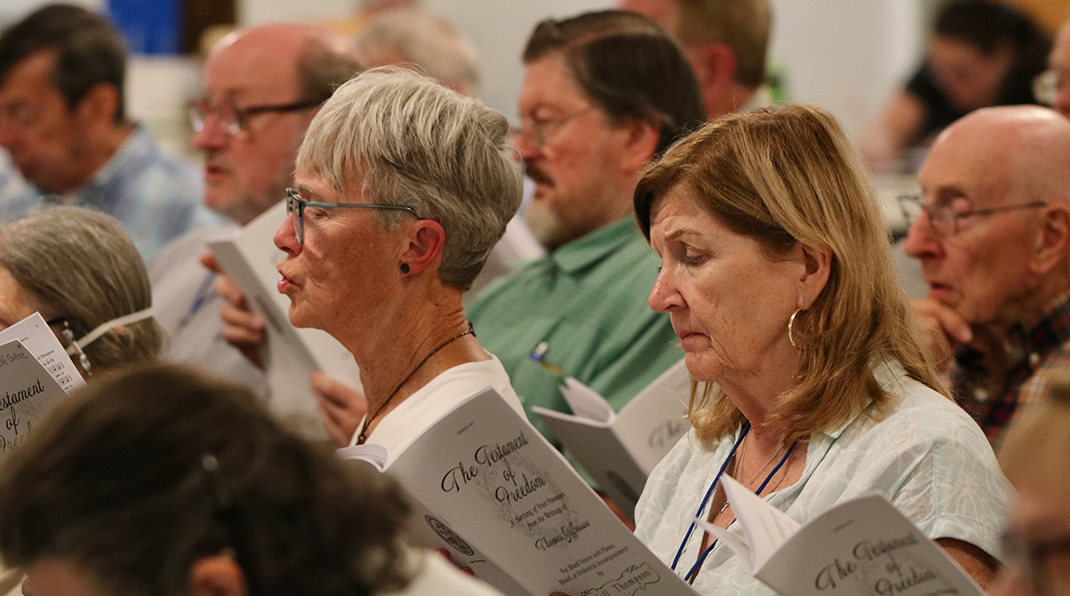
Singing a Song of Rochester
What the Rochester Oratorio Society sings is the heart and soul of where we live — the group is celebrating 80 years this year
By John Addyman
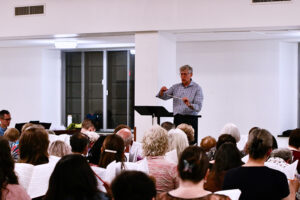
What might you be doing on a weeknight, after work and dinner … with 100 or so others?
Everyone is friendly. But everything is also business.
You’re devoted to what you’re doing and you’re also very sensitive to follow the directions of the guy in front of everyone. You love how your contribution matches others near you.
What’s happening is creativity in search of perfection.
And you’d be singing, of course.
The Rochester Oratorio Society (ROS) has 174 members, 160 of whom have signed on to sing the current program and repertory as the group celebrates its 80th year of making music.
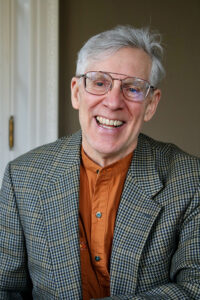
It isn’t just a choir. Through the guidance of director Eric Townell — just the third director in those 80 years — the ROS is the voice of the essence of Rochester.
Just think about that. You love music that has become familiar to you. What Townell and the ROS are doing is helping you find a rhythm that’s been uniquely Rochester. Those 130 voices weave an aural cloth that warms you in winter and cools in summer.
Townell came to Rochester in 2006 to guide the ROS and he realized just how important music is here, how deeply it sits.
“I studied who lives here and why — I realized that ROS needed to make some changes to better reflect the community we serve, the people who live here and the values that built this place in the first place,” he said. “In Rochester, there’s a long history of innovation, respect for hand-built things of ultimate quality, community tolerance and mutual respect — I think that’s a very strong fiber in our community.
“Being the ROS gives us the opportunity to celebrate those qualities that make our community strong and enduring — a wonderful place for an artist to live and also a wonderful place for entrepreneurs and visionaries, no matter what their walk of life.
“Those were values that came down the Erie Canal and with the westward expansion and the second great awakening and all of the new wave of consciousness that came our way in the years preceding the Civil War. The scholars and formative thinkers who took the ideals and thought spiritually about life here and founded new religions and founded new community organizations and built institutions that survive. We educated the first nurses, for instance, the first women in medical professions. There have been astounding innovations that grew out of these values.”
Rochester Oratorio Society was organized by Theodore Hollenbach in 1946 and he led it for 40 years. Roger Miller followed him as director for 20 years.
“I’ve been able to continue the work they did with their visionary planning,” Townell said.
 With a music degree in tuba performance from Indiana University, Townell got his master’s degree in orchestra conducting at Northern Illinois University and earned his doctorate in orchestral conducting from the Peabody Conservatory in Baltimore in 1997. He led the Central Wisconsin Symphony Orchestra, a choir in Madison, another choir in Milwaukee and a small opera company in Milwaukee as well as the Madison Opera.
“As a chorus director, I learned on the job,” he said.
The job at ROS seemed so right.
“I’ve always had a choir,” he said. “For me the happiest spot is where instruments and voices meet and where I can have the special synergy that happens there. We’ve been fortunate here in Rochester to work with professional players from Local 66 Musicians Union — they can play anything.”
Coming to Rochester, he found a prepared musicianship ready for him and after his research, he had a direction to take the ROS in.
“The values and the vision we can celebrate — that’s part of our heritage, that’s the core identity. We’re addressing that through our music,” he said.
For the celebrations of America’s 250th birthday this year, the ROS has developed a program to reflect that heritage and identity.
“The music uses the Thomas Jefferson text of the Testament of Freedom by Randall Thompson and “Be Glad Then, America” by William Billings. Also offered is “We Are On Native Land” by Brett Michael Davids, a native American and nationally renowned composer. The music directly relates to the great removal that happened in 1825 and it incorporates locally developed text by an indigenous poet, Patricia Corcoran, who is Haudenosaunee,” Townell explained. “The music was provided by Brett without any lyrics and setting those lyrics to Brett’s music was a Cherokee musician, Kae Wilbert.
“We’re also doing “A Hymn for America,” by Stephen Paulus. And we’re presenting a vocal recital by a Rochester native, a graduate of the School of the Arts and Fredonia State, X’zaya Ivy.
 “A soprano, Ivy grew up here and is a wonderful success story. She has developed a program around the Harlem Renaissance, Langston Hughes poetry and the local connections to the early 19th Ward neighborhoods as Rochester developed westward along Main Street, where the richness of our culture was. That was where Nathaniel Dett lived and taught, he was a world-class composer who paired African-American folk songs and spirituals with classical themes.
“In every way we can, we’re trying to show how parallel tracks of black America and European-influenced white America co-existed here and developed in tandem, borne out by the music we sing and the events we create, the values of our community, the people who live here.”
“That’s what we sing and serve, those values and those people,” Townell added. “Those are essential to our sustaining, our sustenance as an art organization, that’s what every art organization has to do.”
ROS is a “community of avocational choristers,” Townell explained.
Unlike many other symphony choruses today, the ROS has no paid singers “but many of our members are employed as musicians,” he said. “They are church choir directors, public school and college music educators or professional soloists for churches.
“We’re just fortunate that they share their talent with us because this is what they love to do. Singing in a musical choir feeds their musical soul in a way they need, even if they’re directing others on how to do it or teaching voice. We have many voice teachers in our group: that gives us a good level of skill and it’s always been that way for ROS.”
The ROS presses five efforts into the greater Rochester community:
• the main 130-voice symphonic choir with its robust repertoire,
• the small-ensemble Resonanz choirs that sing everything from Christmas carols to pop music and jazz standards in library concerts, civil events and special performances at museums and national historic sites
• the Emerging Artists competition in the spring and the Rochester International Vocal Competition in the fall (in its 20th year)
• the Arts Connexions series of smaller-format vocal and multi-media performances in non traditional settings
• the cultivation of new singers through collaborations with the School of the Arts, Roberts Wesleyan, Bach Children’s Choir, Hochstein Youth Singers, Genesee Valley Children’s Choir and more.
The Arts Connexions programs are an interesting temptation.
“These are professionals we bring in,” Townell explained. “These artists offer another avenue for people who wouldn’t ordinarily come to a choral concert.”
The idea is to pique interest and hope that transforms into a larger listenership.
“Our audience has been gradually growing,” Townell said. “I think there are barriers to arts participation that extend across all the disciplines. Like cost — cost is the main impediment, ticket cost, admission cost. Ticket prices are high. We try each year to have some events people can attend and appreciate — free.
“What we’ve tried to do is see who is in the audience that hasn’t been there before. Each of these projects seems to have its own boutique audience and they find themselves sitting next to people they’ve never been with in an audience before. That is worth its weight in gold to us. And we’ve tried to develop as many hooks into the oratorio as we can. There are a lot of avenues in. If this piece doesn’t appeal to you then the next thing you might hear is a Spanish piece that reflects your culture. Or it’s a black soloist or composer who reflects your culture. Or it’s a work like Ernest Bloch’s ‘Sacred Service’ Jewish liturgy. There are sacred audiences more and more now.
“We have non-audience-related things that also sustain the group. One of the big things we do is music education for urban youth, which we’ve done for the last five years. We’ve done many school and library performances with small ensembles — up to 20 of those a year — in Webster, Parma, Canandaigua, Geneva, Mendon — all around the region — that bear out our history and traditions and values.”
Townell believes the pieces he’s chosen for the ROS to perform “speak to the people who live here and our participants onstage reflect the communities that are here. In a nutshell, that’s what we try to do. You could look for that thread in what we’ve done from 2009 to today. They called what we’re doing ‘diversity, equity, inclusion.’ But the hard part, more or less, is to be valued in that regard. And that is very much our legacy and will be for many years more.”