

The Evolution of a Contemporary Artist: William Keyser
By Lynette M Loomis
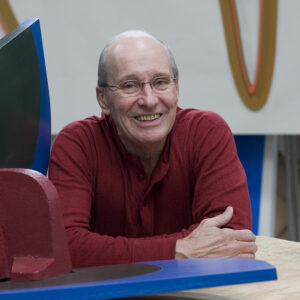
I was sitting at a picnic and asking the gentleman next to me about his interests. He said he had taught at RIT and enjoyed woodworking, sculpting and painting.
I thought he might be interesting to write about, so we exchanged contact information.
After researching him, I called a friend and said: “We were sitting next to a genius and didn’t even know it!”
Bill Keyser and his wife, Joan, graciously invited me to their home.
They live in a one-story home nestled in six acres of woods and lawn in Victor. Natural light streams throughout the entire house, displaying much of his work as a renowned contemporary artist.
His quiet demeanor shows no ego despite the critical acclaim for his work and the fact that his bio is saved in the Archives of American Art at the Smithsonian.

He is regarded as a key figure in the American Studio Craft Movement. In July he celebrated his 90th birthday.
As I walked through his home, it was like visiting a fine museum.
My head swiveled around and around as I admired all his pieces, perfectly placed and integrated in a flow of movement. His work is unique, detailed, perfectly executed and reflects his personality.
“I look at the world through a different lens, I’m told,” he tells me. “I see potential in every scrap, everything that’s disregarded or discarded, the debris of life, for many of my ideas. I see it in a way different than its intended use.”
His eyes looked directly at me as we walked through his house, explaining the origin of pieces and the process by which they were created. He answered my questions with an easy grace and humor. A circular staircase took us down to his studio, where he sculpts, paints, and practices yoga. He works in his studio three or four hours a day.
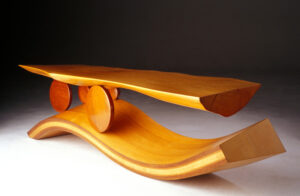
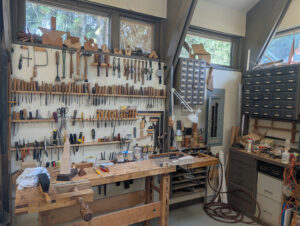
His woodshop is housed in another building, designed specifically for woodworking, filled with lathes, saws, belt sanders, a table saw and the hand tools necessary for the precision woodworking for which he is best known. All meticulously organized for maximum efficiency.
It occurred to me that one can be imaginative, creative and organized — a new concept for me. It smelled of sawdust, reminiscent of my father’s small wood shop.
He came to work with wood in his childhood, the result of a skilled woodworker father and some uncles who were plumbers and blacksmiths. At age 8 or 9, his dad took him to his first job site to remodel a kitchen and he spent the next years working evenings, Saturdays and school vacations with either his dad or his uncle. His favorite magazine was Popular Mechanics, and tools were his favorite gift. Two things changed his life, one of which was his entry into the Soap Box Derby.
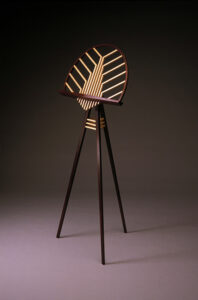
“I was interested in model airplanes but never completed one; then I gravitated to model railroads, but soon lost interest. In fifth grade I heard about the All-American Soap Box Derby but was age ineligible for two more years. In the meantime, I designed and built scale models of Soap Box Derby racers. I had no problem completing the scale models and then building full-scale racers. What I realize now is that my sustaining interest was in designing and building these original models; I thrived on working with my imagination and my hands,” he said.
From seventh grade through his four years at North Catholic High School in Pittsburgh, he competed in the All-American Soap Box Derby five times; the Fisher Body Craftsman’s Guild model car competition four years and the Buhl Planetarium’s School Science Fair three times. He had no time to hang out or socialize with friends or play sandlot sports or games.
“Fearful of being viewed as a geek or a nerd, I participated, with considerable success, in intramural boxing in my junior and senior years, which earned me some respect,” he said.
As a freshman in high school, his model car won him a trip to Detroit for the Nationals in the Fisher Body Craftsman Guild competition. He didn’t win a national award, but he saw the winning entrants that featured chrome-plated brass bumpers and fine sprayed lacquer finishes versus his lack-luster aluminum trim and hand-brushed enamel paint job.
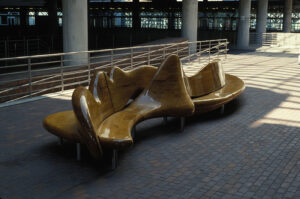
In his words, “I said to myself that they are so far beyond my ability, I’ve got to crank up my act a few notches.”
He did step up his game and the following year won the Second National Junior Division Award and a three-year college scholarship.
In his second year competing in the Buhl Planetarium School Science Fair, he built a model automotive stamping and forging plant, which won best of show and several engineering awards. This all suggested a career in engineering, so on to Carnegie Mellon he went. He quickly became dissatisfied with the highly technical courses and the lack of building and wanted to switch to fine arts. His mother advised against this. “Stick with engineering. When you’re making money, you’ll enjoy it more. He didn’t. He could only imagine himself as a mediocre, alcoholic engineer, living under a bridge somewhere.
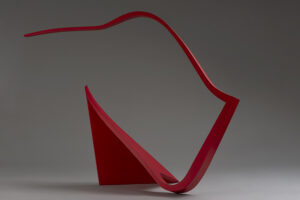
Longing for the opportunity to design and make things, he attended an evening jewelry class at Kent State. His adviser suggested he enroll in the School for American Crafts at RIT for a Master of Fine Arts degree. One assignment was to research an aspect of woodworking or furniture design, prepare a class and present it. He loved it because he could teach and have his own studio.
“I am a woodworker who teaches,” he said. “If I had 10 students, I would like them to go in 10 different directions. Then I’d be doing my job. Students need to be able to work with ideas, clients and architects while using their own creativity and executing it flawlessly.”
Harold J. Brennan, dean emeritus of the College of Fine and Applied Arts at RIT, said, “Although William Keyser’s work is done in a thoroughly contemporary spirit, it stands far away from that of his fellow artisans. Keyser’s work properly holds a place among the best shown in his field.”
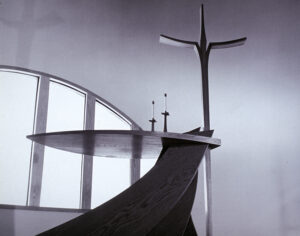
“As I was working on commissions, I concentrated on evolving the piece to the point where it looked like the drawing,” Keyser said. “The sketching phase was always the most challenging part. I found myself looking over in the corner and seeing the scraps lying about the band saw, or one of the machines and seeing things in those that seemed a lot more interesting to me than the object that I had just been working on for four or eight weeks. And so, I began using these leftover parts, sometimes the debris, from a project as beginnings for a speculative piece.”
The practice of using materials in unusual ways makes his work an artistic puzzle.
The creative genius of his comes from that unique view of the world. What could be possible?
“My degree in mechanical engineering taught me traditional ways to use materials, but I have always enjoyed testing the boundaries of a material. How far can it bend or what weight can it support in an artistic application?” he said.
As he was creating wood designs that received critical acclaim, his wife, Joan, offered a critical eye.
“Marrying her was the best decision of my life,” he said.
They have been married for 65 years.
“She has a good sense of what looks right, knowing my mindset and adding her perspective. She is a creative person, especially when it comes to food,” he said.
Joan worked at RG&E in the demonstration kitchen, then developed recipes for French’s. Later, she joined Wegmans and collaborated with the photographers for Menu magazine. Her role was to create the food and ensure it looked appealing despite lighting conditions that made ice cream melt, lettuce wilt and sauces congeal.
One woodworking niche was commissioned wood pieces for churches and temples. He created 23 complete, multi-piece sanctuary ensembles plus several singular pieces. He collaborated with architects to develop an overall theme that would flow into the environment.
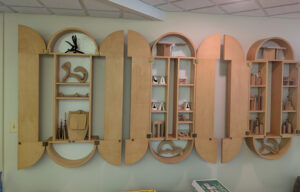
“I always went through an extensive sketch stage. It was the blood, sweat and tears part of the project, producing the design,” he said.
His work has touched thousands of people in their places of worship, he added.
He taught at the RIT School for American Crafts for more than 35 years. His commissioned wood creations are found in art galleries and museums, including the Burchfield Penny Art Center (Buffalo), Carnegie Mellon University, the Sheldon Museum of Art (Nebraska), the Museum of Art and Design (NYC), Art Park (Buffalo), Memorial Art Gallery, Nazareth College, RIT, churches, and private homes. He received seven significant awards, including the grand prize in Modern Liturgy Visual Arts, an award for outstanding achievements in sacred arts, liturgical design and church architecture.
“My modest picnic companion is considered a key figure and pioneer in the American Studio Craft Movement,” he said.
After decades of sawdust and teaching, he stopped teaching to add another chapter to his creativity.
“I had a dream that left me with a feeling that there was something important I needed to do in the next phase my career. But I didn’t know what,” he said.
He moved away from teaching to become a student, and his teaching peers became his instructors. At age 64, he went to school part-time and earned an M.F.A. in painting at RIT.
His paintings and sculptures are contemporary, abstract, and intriguing. Another major influence on Bill’s artistry was “Contemporary Sculpture: An Evolution in Volume and Space,” which is now a beloved, dog-eared book in his studio. “Every aspect of painting is creative. With furniture, you know when the piece is completed, but with painting and sculpting, I ask myself, ‘Is it done?’”
Examples of his sculptures and paintings have appeared in the Burchfield Penny Art Center’s Art in Craft Media, 2017-23, receiving a purchase award in 2019. James Hall, owner of the Oxford Gallery, has managed his work for 20 years.
“Bill Keyser took degrees at RIT in both sculpture and painting and his work, as one might expect, embodies the best aspects of both form and color,” he said.
“I’ve always been a practicing Catholic, but, you know, I’m not overt about it. But I’ve always believed in the presence of a supreme being. I refer to it as a supreme artist. I’ve come to believe that whatever I’ve been able to achieve has really been his work more than mine, that I’m just a vehicle,” he said.
He was inducted into the North Catholic High School Trojan Hall of Fame in October.
William Keyse’s work may be found at www.williamkeyser.com.