
Creating Something Out of Nothing …
… and sharing it with the next generation
By John Addyman
When I was 10 years old, I wrote an epic poem — kind of like “The Odyssey” — on my gray elementary school tablet.
I filled it to the last page with lurid tales of robots doing all kinds of nasty things to people, inspired by Isaac Asimov’s book, “I Robot.”
I made drawings and maps that absorbed so much of my time. But I never developed a hero.
Roger Dowd took the opposite approach and developed a hero first — Edward Aaron Hurt, a young journalist who thirsts for adventure as an Antarctic explorer in the 19th century.
With patience, an interesting background and a lifetime of artistic expression, Dowd, 79, arrived in Brockport in 2021 wanting to make something significant of his own…and share it. The blushing years of a healthy retirement gave birth to a graphic novel and so much more.
Like any graphic novel — a story constructed principally of pictures, like a grown-up comic book — Dowd’s work is full of pictures and color and images.
But Dowd, who has a degree in animation and illustration from the Pratt Institute and a career as a graphic designer, senior art director, web developer and marketer, decided to take that graphic novel a couple of steps further.
He conjured up young Edward Hurt, yes, then he invented a late 1800s airship, created a whole separate phylum of strange animals and imagined a frozen Antarctic mountain with lush interior vegetation and a temperate climate.
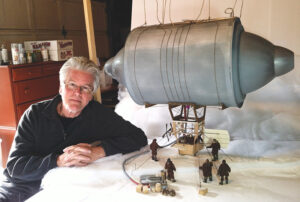
Dowd blends his story with detailed visual art he’s developed on his own and with computer help. He created scenes and placed Hurt and his crew in them. He adds characters like Queek — the son of Herman Melville’s Queequeg — and expedition naturalist Dudley Field, named after Dowd’s dad, Dudley Field Dowd.
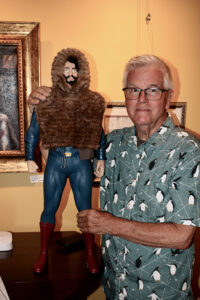
Dowd illustrated his story, “Hurt of the Antarctic,” but he also invented and constructed toy figures and landscapes and airships. He found out how to “kitbash” — sacrificing a huge action figure of Superman and reshaping, recostuming and adding hair to create and embody Edward Hurt. Dowd’s two-dimension graphic novel of historical fiction came to life from three-dimensional creations.
“All the writing, all the illustrations, all the artwork is mine,” he explained.
What’s also his are all of the pieces you see in the graphic novel — all the figures, all the devices, the expedition’s ship, the landscape inside the volcano, the airship — he’s built them all, staged them in dioramas and photographed them.
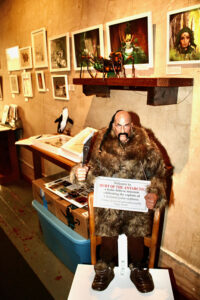
He’s created ephemera to bring Hurt’s world to life, like a copy of a pulp fiction magazine (with extra-rare Antarctic alligators), newspaper editorial pages, maps of islands and mountains, even 19th-centry ads for skin tonic. It’s a remarkable and unique collection.
The variety of visual effects he’s painstakingly put together are on display at his tiny portion of the Hart Gallery on Market Street in Brockport.
And he’d love to show it all to you.
“I was hoping to make a living as an illustrator and maybe as an artist,” Dowd said.
That was a long time ago.
“I realized people weren’t going to pay me to express myself. I got a real job in an advertising agency in New York, then I worked for magazines — I was a graphic designer for Encore and Essence magazines. I worked for a division of Thomson Reuters in medical publishing and ended up being a senior art director of Medical Economics. Then I became a web designer and launched the website for Medical Economics in 1995. I’m glad I did that. A lot of people didn’t make that step back then.”
A corporate buyout in 2006 put him on the street. “I was downsized and I started my own business — a graphic design, web design and marketing business,” he said. “I retired when I came to Brockport three years ago. Now I do a lot of volunteer work for nonprofits as a web and graphics designer.”
Dowd moved into this area from Goshen, Orange County, where he had created material for the Goshen Historic Track and the William Henry Seward Homestead (Seward was Abraham Lincoln’s secretary of state, a senator, a governor of New York, and is noted for purchase of Alaska).
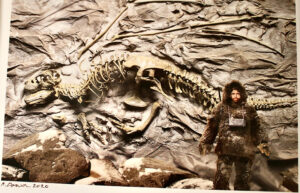
“I’m interested in volunteering for historical societies but in my private life, I create fantasy history, that’s what ‘Hurt of the Antarctic’ is all about — it’s make-believe history. It’s historical fiction inasmuch as the protagonist is anchored in a certain period and that’s why there are references to real, contemporary events,” he said.
Young Hurt leads an expedition to find the south pole in the 1880s, encountering adventure and tragedy.
“All the artwork in the book, all the copy is mine. You see my pen-and-ink drawings, my watercolors in the book,” he said.
His Hart Gallery exhibit “functions as a companion piece to my book. If you come to my gallery, you see my drawings and because I’m a graphic designer, I also work with different applications to kind of meld things. That’s why I built dioramas. In my gallery are examples of the models that went into creating the scenes in the book,” he added.
‘I’m like your uncle or grandfather’
Dowd has happily stepped into a special role in programs for kids in Goshen and in Batavia, where he has taught five-day classes to teens and tweens about kitbashing.
“I have an option to be a temporary grandfather in the sense that I’ve had classes and creative artistic workshops where I encourage kids to see what I’ve done with a Superman action figure,” Dowd said. “I tell them, ‘Why don’t you take an action figure you have — or anything — and modify it? That figure will become your own action figure, wherever your imagination takes you.’
“When I started this whole project in Goshen, there was a library there that wanted to have educational programs for kids during school recesses. Their mantra was, ‘Let’s get kids away from their PlayStations.’ I showed one of the directors of the library the book that I was working on and she said, ‘Oh, kids might like that!’ So, I created these how-tos, taking existing action figures and then morphing them into new characters.”
Dowd added that the original storm trooper action figures from Star Wars began life as Fisher-Price truck drivers before they were kitbashed to storm trooper toy prototypes.
He explained to his workshop students that when they start kitbashing, “as soon as you add clothing to them and add things like doll hair, they actually look more realistic and interesting. When they photograph, they look real.”
Visiting his make-believe museum at the Hart Gallery, you can see the transition of figures and construction of all the parts of ‘Hurt of the Antarctic.’
“I’m like your uncle or grandfather who’s been working on his trains in the basement for 30 years. It’s a passion. It’s a creative outlet and I always wondered…if you go to any museum, how are stories told? To learn about Thomas Jefferson, for example, you go to Monticello, to the museum. And you learn about him in fragments, in artifacts, snippets of his life,” he said. “So, I thought, what if I told a story in fragments, like a connect-the-dots. You start with A and end up with Z. I have these items preserved so kids can see how they’re built.
“One of my greatest pleasures this year was that I did a five-day children’s workshop during the winter recess in the schools for the GoArt! gallery in Batavia. This is where youngsters were to work with action figures and what they came up with was stories about the figures they created — really crazy, funny things…like aliens.”
“What I do is a way of giving back and a way of encouraging kids to be as creative as they want to be they need to follow their instincts,” he added. “Too often adults try to teach kids what art is, but their understanding of art might be limited to just what they like. Kids can be an influence on an artist. My son, Nathaniel, introduced me to anime and maga storytelling platforms. I got a book on maga how-to to share with kids if they’re interested in going in that direction. It’s really surprising how imaginative kids are. I’m often impressed with the stories they tell with their art. I don’t think that should be discouraged. My father, who had artistic ability, made sure I had the tools to go wherever my imagination took me — the crayons, the pencils, the paint and the tools so I could go wherever my imagination took me.”
You can tickle your curiosity about Dowd’s creations and development process through his website, www.rogerdowdcreative.com, or visit him in the gallery.