
More Than Just Jazz
Players in Mid-Century Modern Jazz Quartet come from all walks of life
By Mike Costanza
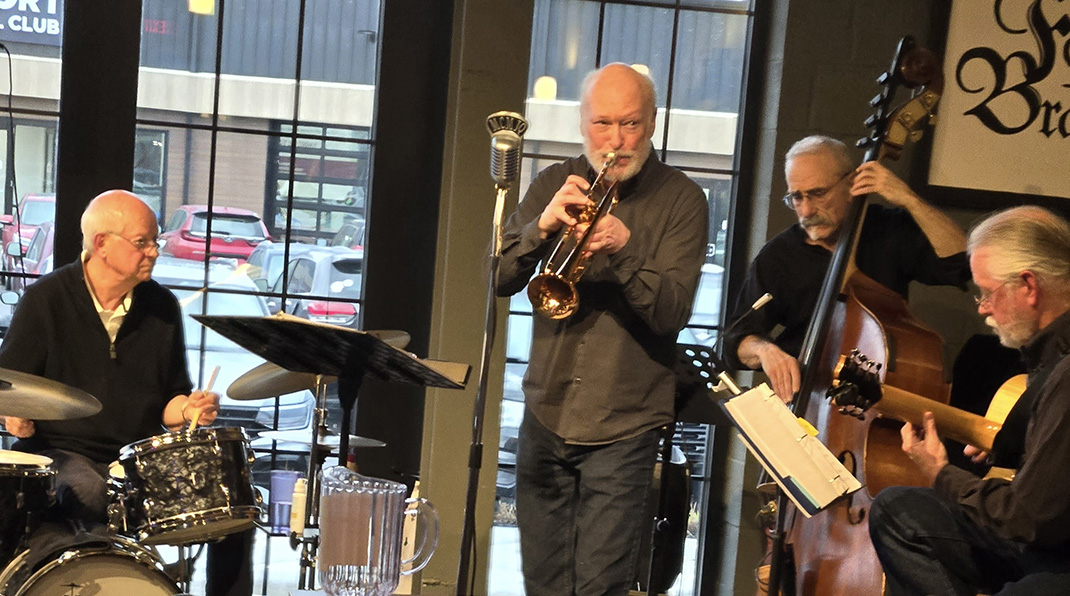
For the Mid-Century Modern Jazz Quartet, the pleasure of performing isn’t just in the music.
“I have more fun with these guys than any other band I’ve played with,” said 74-year-old Al Biles, the retired Rochester Institute of Technology professor who co-founded the group.
MCMJQ treats its audiences to an eclectic mix of works by jazz greats who performed from the mid-1930s through the 1960s.
A single performance might include works by jazz legends like saxophonist Sonny Rollins, the late pianist and composer Thelonious Monk and the late trumpeter and band leader Miles Davis. In keeping with the improvisational nature of jazz, each performance is a kind of musical conversation among the musicians.
Biles, Chuck Dye, Bruce Goldman and Steve Gates, all came from a variety of backgrounds to form MCMJQ. Gates, another founding member, first picked up a drum when he was a child growing up in Independence, Iowa.
“I have a picture of me with a little teeny drum set when I was about 8 years old,” the 77-year-old Rochester resident said.
While in his mid-teens, Gates played the drums with a local jazz band that played hits by Count Basie and other famous musicians at places like the Surf Ballroom in Clear Lake, Iowa and other clubs in Northern Iowa, Minnesota and Wisconsin.
“I was too young to even to have a driver’s license, so a local band director who played tenor sax in the same band agreed to drive me to the gigs,” Gates said. “It was a great, great foundation in doing the kind of music that I was in love with.”

He went on to study music and percussion at North Texas University, spend four years with the US Air Force, including one in Vietnam and become a commercial pilot. After flying for the University of Iowa for about 15 years, he became a pilot for United Airlines, where he stayed until he retired in 2008. He and his wife have lived in Rochester since 1988.
Gates has appeared at the Rochester International Jazz festival three times and played with such local jazz greats as Johnathan Feldman, Sonny Miles and Katie Ernst. Many Saturday mornings, he could be found making music with Jack’s Jammers, an informal group of musicians that came together to play jazz for the fun of it.
When Dye was growing up in Penfield, his late grandmother taught him the rudiments of playing the mandolin.
“My grandmother played by ear and I started playing by ear when I was about 8 years old,” the 72-year-old said.
He acquired his first acoustic guitar at 11 and by about the age of 13 had managed to scrape together enough money to buy his first electric guitar. He also acquired a love of jazz from his father, who had a collection of records by legendary artists like Dave Brubeck and Ella Fitzgerald and once took him to see Duke Ellington at Rochester’s Auditorium Theatre (now the West Herr Auditorium Theatre).
Dye played in local rock bands and in Penfield High School’s jazz ensemble and eventually came to own several guitars.
Dye married, raised a family and acquired a master’s degree in business administration from St. John Fisher University while working in a series of responsible positions in the Rochester area. The demands of his family and work led him to put aside music for a time and get rid of most of his guitars. After his children graduated from high school he returned to music and bought his first seven-string guitar, preferring the deeper sound it could produce.
“It allows you to put a bass note on a chord that you already know how to play,” Dye said.
He began playing guitar around the Rochester area and with Jack’s Jammers and in 2018 retired as the human resources director for Wayne County.
Biles began playing jazz trumpet while attending high school in Salina, Kansas.
“I didn’t really get serious about it until I started sitting in at jam sessions in Lawrence, Kansas, when I was up at KU [the University of Kansas],” he said.
He played jazz and other styles of music with a number of local bands, including one that traveled around north central Kansas in an old school bus that was painted chartreuse and orange.
After graduating from KU in 1980 with a master of science degree in computer science, Biles headed to the Rochester Institute of Technology to join the faculty of what is now called the Department of Computer Science. He played jazz with local groups while pursuing his academic career and met up with Dye and Gates during sessions of Jack’s Jammers. In 2016, the three decided to form a quartet with the late Tom Lange, who played the double bass. For the first few years, whoever booked the quartet for a gig got top billing — if Dye booked a performance, the musicians would appear as the Chuck Dye Quartet. Biles retired as a full professor in RIT’s School of Interactive Games and Media in 2019.
You might say that physician Goldman came to MCMJQ indirectly through his medical career.
Goldman began studying the trombone as a 10-year-old living with his family in a Chicago suburb. Though he acquired a love of jazz in middle and high school, he entered Northwestern University intending to become a symphony trombonist.
“I love the trombone. I love the symphonies that have trombones in them,” the 73-year-old Rochester resident said.
The path to symphony trombonist proved too uncertain, and Goldman turned away from it. He transferred to the University of Illinois and after graduating with a Bachelor of Arts in music took a job with a local hospital. On the advice of a co-worker, he applied to medical schools. He was accepted at Northwestern University Medical School, which he entered intending to become a family practitioner. While there, he did medical research that led him to specialize in pathology.
Goldman was doing a pathology residency in New York City when he decided to feed his love of music by learning to play the double bass also known as the upright bass, with which he’d become familiar while studying the trombone. He began taking lessons and his passion for playing it grew.
“I was supposed to be training as a pathologist then, which I was, but every free moment I was practicing the bass,” Goldman said.
After spending nearly 20 years with Temple University in Philadelphia, Goldman took a position with the University of Rochester Medical Center as a professor of pathology and laboratory medicine. He retired from that full-time position in 2016 and now works as a part-time professor in the Department of Pathology and Laboratory Medicine. He began playing gigs with Biles, Dye and Gates after Lange died and the four decided to give their quartet its current name.
Since then, the members of MCMJQ have brought their love of jazz and of performing together to venues in and around the Rochester area once or twice each month. Dye values the group’s supportive nature.
“If I were to get lost in a tune, somebody’s going to get me back to where I need to be,” he said. “If I do something that I think will be interesting, I know that Steve and Bruce, our bass player, will be supportive.”
That close interaction also helps keep Biles mounting stages with his trumpet and flugelhorn.
“We kind of complete each other’s sentences. So musically, the conversation is really, really good and that’s essential to jazz,” he said.
For Goldman, that camaraderie boosts the pleasure of playing jazz.
“We have a sense of simpatico and affection, I guess would be the word, musical affection and respect for each other and all that together makes playing a joy,” he said.
Gates sounds surprised that he’s still playing jazz.
“If you had asked me 20, 30 years ago would I be doing this much drumming at the age of 77, I wouldn’t have imagined it possible. But I love it,” he said.
For more information on MCMJQ or to learn where it will play next, go to: https://mcmjq.com