
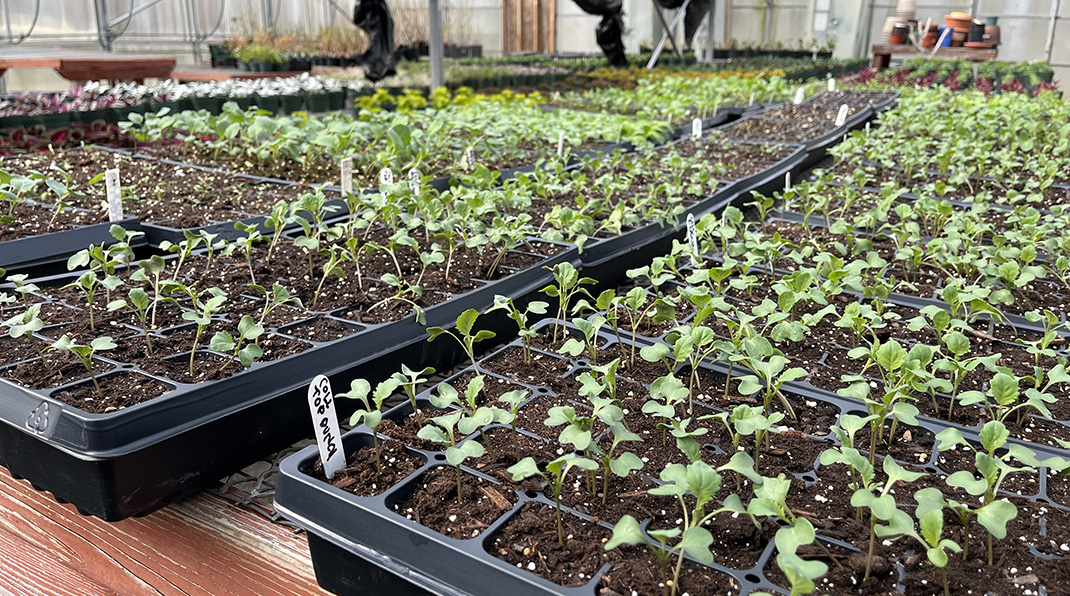
Growing Indoors
Sure, you can start growing things to eat indoors right now — all you need is proper lighting
By Deborah Jeanne Sergeant

Although we have many weeks of winter ahead, gardeners need not wait until spring. It is possible to grow things to eat indoors.
Dick Rizzo, master gardener with Monroe County Cooperative Extension Master Gardeners, said that the biggest issue with growing plants during winter is light.
“When they say you can grow something with six to eight hours of light, that’s what the plants need minimum and it has to be direct light, not when there’s something in the way,” he said.
This would require a south-facing window that doesn’t have trees blocking it. Rizzo added that often, growers need to supplement that with artificial lighting in the winter. An ordinary lamp’s light bulb won’t do.
“Grow lights give you the wavelengths of lights plants need,” Rizzo said. “A cool light fluorescent will have a lot of blue wavelengths, so that’s fine. Grow lights are nice and especially if you want plants to flower. Growing herbs and sprouts you don’t really need that. If you use LED lights, it’s tricky. You need it to say ‘full spectrum.’ Plants collect light from blue and red in the spectrum. The yellows and greens they don’t use as much. If you use grow lights 12-16 hours a day and your plants will grow.”
Trying to grow plants with too little light results in plants that are “leggy” or long in their stems but not producing as much.
Rizzo said that it’s also key to separate plants in their own containers and use an artificial soil mix supplemented with liquid fertilizer at half strength to avoid over-fertilizing. Potting mix is also an option, but Rizzo said it’s easy for that to dry out and become hard.
Pots should have drainage holes to help avoid the roots of plants sitting in water. Only water when the soil surface appears and feels dry. Rizzo added that plants grown indoors don’t need as much water.
“If you’re growing herbs, once it’s established, you can just water it occasionally with fertilizer once or twice a month,” he said. “If they start to look a little yellow, it needs a little fertilizer.”
He said that basil and chives are easiest to grow indoors.
Microgreens are harvested early with scissors and don’t grow to full size. Spinach is fast-growing and an excellent example of an easy-to-grow microgreen.
“You could grow that on three-inch-deep tray and have a tray full,” Rizzo said.
The light needs to be within 12 inches of the tray.
Indoor sprouting can also provide a nutritious boost to salads, sandwiches, soups and casseroles. Rizzo cautioned that growers need “seeds designed for indoor use or for sprouting that they’re not treated with mold inhibitors as that’s poisonous. Get organic seeds or those designed for human consumption.”
Sprouting does not require as much water as plants with roots.
“You just need a moist surface,” said Marci Muller, horticulture team leader with Monroe County Cooperative Extension. “You can use a damp paper towel. You need to get them off of it quickly or you’ll have paper towel in your sprouts.”
Sprouting kits with screens and seeds can help you get started. Since sprouts can grow moldy quickly and grow quickly, it makes sense to sprout a small amount to use up and continue to start more as needed.
As for seeds used for plants and microgreens, Muller said that heat under the planting tray is important for getting them started. Once they sprout, light is necessary.
“Most herbs are full sun,” Muller said. “Once they get past germination and start growing, they need sufficient sunlight to be strong or they’ll get leggy if they don’t have enough sunlight. Most herbs prefer to be moist to dry. But some things like basil have greater water needs than some perennial herbs. Be sure that you provide enough moisture. If it needs more, it will start to wilt pretty quickly. The best thing to do is to stick your finger in the soil. If it’s wet, wait to water it. You might water every other week.”