
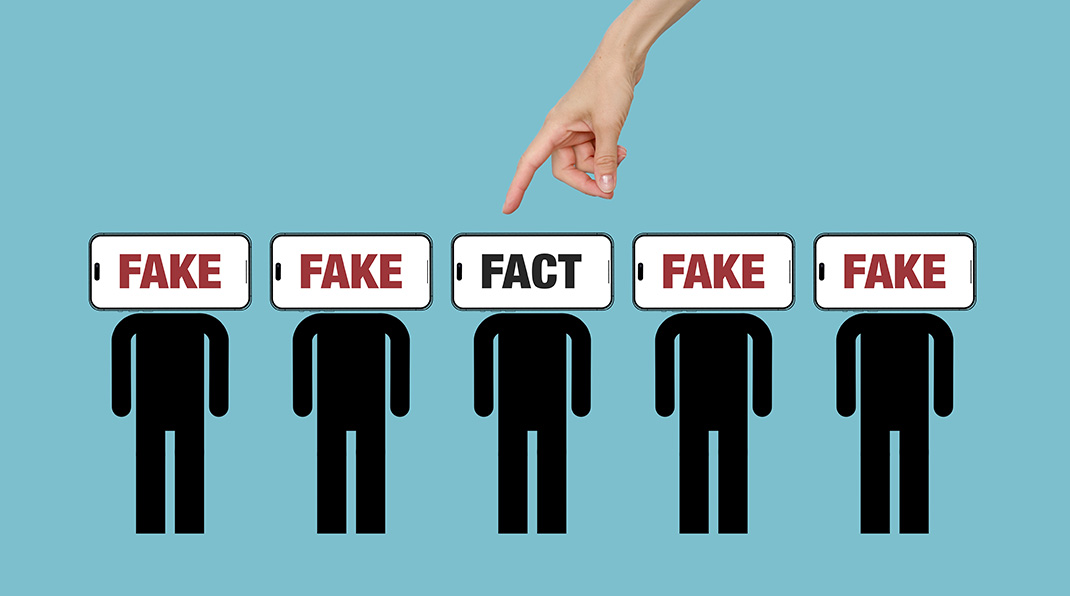
Telling Fact from Fiction in Politics
RIT professor says AI is making it harder to separate fake news from reality
By Mike Costanza
Sarah Burns, associate professor of political science at the Rochester Institute of Technology, said Americans have a right to be concerned that they might not be getting accurate and honest information about US elections.
“There is so much misinformation and disinformation and malinformation that it’s very difficult for Americans to parse out all those aspects of the information environment,” she said.
Burns has studied the kinds of inaccurate or false information that can arise in US politics and the ways that people can avoid being guided by them.
Given the results of recent surveys, her findings should prove useful to anyone who follows politics.
Only 8% of the nearly 25,000 Americans polled by Northwestern University researchers in 2023 were able to correctly identify all the false political information presented to them. A Pew Research Center survey that was conducted prior to the 2024 presidential election revealed that 73% of American adults encountered inaccurate news about presidential election extremely, very or somewhat often. Of those surveyed, 52% said they’d found it difficult to determine whether the information they’d received about the presidential candidates or their campaigns was or wasn’t true.
Misinformation is false, inaccurate, incomplete or misleading information that someone might share unintentionally. The promises that presidential candidates make while campaigning but couldn’t fulfill after taking office might fall into this category. Ronald Reagan pledged to reduce the size of the federal government but was only partially successful.
“I think he famously said he could not shrink the bureaucracy, so he got two out of three,” Burns said.
In such cases, the candidates involved might have thought they could accomplish their goals and only later realized how difficult it was to accomplish them in our complicated system of government.
Disinformation shares some of the qualities of misinformation, but with a difference.
“Disinformation is when you’re willfully saying something that‘s wrong,” Burns said.
By spreading disinformation, the person involved seeks to mislead or manipulate people for a purpose.
Then–vice presidential candidate J.D. Vance asserted on the campaign trail that Haitian migrants living in Springfield, Ohio, were stealing and eating people’s pets. Even after the story was found to be false, he continued spreading it in order to generate support for presidential candidate Donald Trump’s anti-immigration platform.
“He said, ‘I have to bring attention to this so that people can understand the problems that we’re facing when it comes to immigration,’” Burns said.
Malinformation, on the other hand, “is true, but weaponized,” she said. The information is basically accurate, though it might be exaggerated or presented without context and is used to attack an idea, individual, organization, country or other entity. Because it’s based on something that is true, it’s difficult to counteract.
During the 2008 Democratic presidential primary a photo of then-Sen. Barack Obama dressed in African dress spread widely through the internet. Obama had visited a village in Kenya in 2006, had been given the clothes by its elders and had donned them out of respect for his hosts, but the photo fed into the false notion that he was not a US citizen.
“There’s absolutely nothing wrong with him being in African garb, but it was a signal to people, a dog whistle to people that he was foreign in some kind of way,” Burns said.
The Obama campaign accused the campaign of Sen. Hillary Clinton, who was also vying for the Democratic nomination, of spreading the photo around, but her campaign denied doing so.
Reports that undocumented immigrants proportionally commit many more crimes than native-born American citizens and that they are involved in wholesale voter fraud also qualify as malinformation.
Though members of that group have committed crimes and illegally registered to vote, research has shown that they actually commit fewer crimes per capita than US citizens. Additional research has found that the tiny numbers of votes they have cast have not affected elections.
“Neither of these things are a systemic problem that needs incredible amounts of government resources to address,” Burns said.
Critical eye
New technologies are making it much harder to detect misinformation, disinformation and malinformation and easier to send it far and wide. Generative AI programs, for example, can easily be used to create fake videos, audio files and texts that are difficult to tell from reality.
“Generative AI has increased the speed and ease with which someone could create disinformation and spread it widely,” Burns said.
For those who don’t want to cast their ballots based on inaccurate or false information, Burns has a few tips:
• Critical eye — Prepare to examine incoming information with a critical eye by doing your homework way ahead of Election Day.
“Pre-engage with all the election information before particular things come up in the election cycle,” Burns said. “That does involve a little bit more legwork on the part of the voter, but I think it’s very effective.”
• Use more sources — Check multiple reputable sources when researching candidates and issues, including those that espouse views with which you might not agree.
“A very good thing for people to do would be to pick not only their favorite news source or news sources, but also then try and find new sources from other ideological perspectives,” Berns said. “That would really increase the likelihood that they would have a fuller picture of what’s happening.”
• Consider foreign sources — Even the most reputable US news sources can have biases, so consider including foreign ones that might more objectively cover the US on your list of sources.
“The BBC, I think, does a very good job of just presenting the facts and trying as best they can to convey correct information without any kind of agenda,” she said.
• Avoid obtaining your information from social media.
“If you’re getting your news from social media sources, don’t trust most of what you see there,” Burns said. “They’re designed to hold your attention and they’re not designed with any sense of integrity about what it is they’re conveying to you.”
• Hear different opinions — Try to discuss political candidates and issues with others who do not share your ideology or viewpoints and from whom you might be able to learn.
“It’s really important to see that a lot of people can have differing views from your own without being bad people,” she said.
• Don’t become part of the problem.
“Don’t spread anything that you don’t have three sources on,” she said.
Burns gave a Zoom presentation on the subject of election misinformation, disinformation and malinformation for the League of Women Voters Rochester Metro Area on May 26. She is scheduled to give a second presentation on the ways of detecting these forms of information in July.
Both will be available on the nonprofit’s YouTube page in the future. For more information, go to: www.lwv-rma.org.