
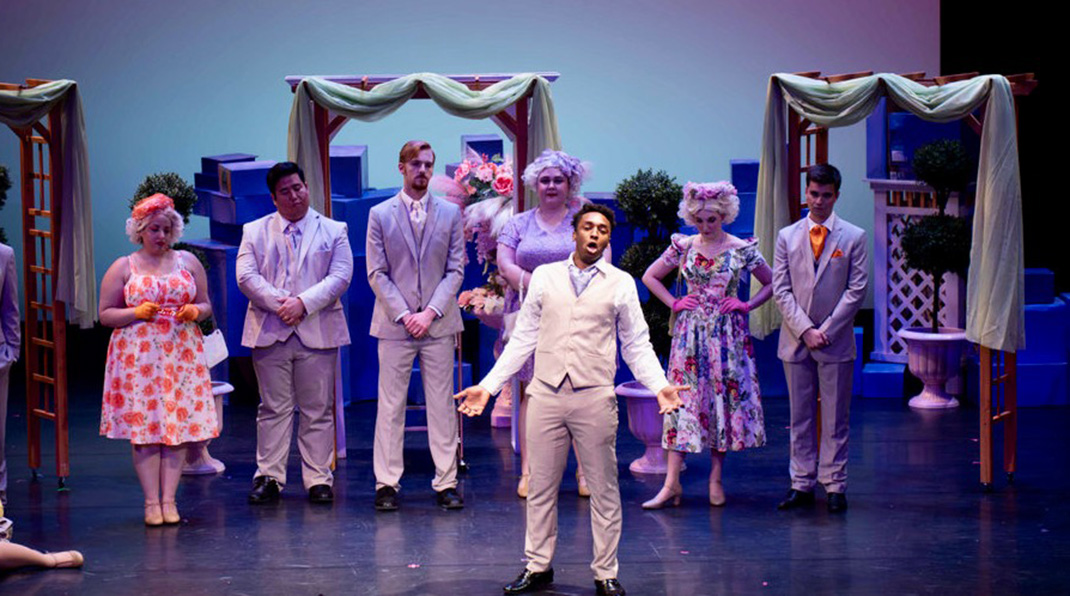
Friends and Finger Lakes Opera Look Toward Breakout Season
By John Addyman
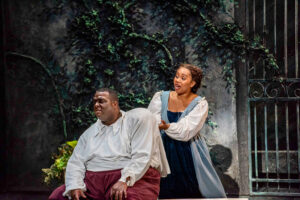
Let’s tell a little story.
A sad one, about a young man, a naval officer, who falls hard for a girl in-country, 6,000 miles from his home. She is so pretty she glows. Raised by her widowed mother in poverty, the girl hopes for love and a happy future in marriage with the young American.
On the wedding day, the young man’s friend takes one look at the girl and asks, “How old are you?”
She’s 15.
“The age for games,” the friend said.
“And for sweets,” the groom added.
Trouble that day includes the girl’s uncle showing up to protest the marriage on several grounds. But the man and girl are wed and swear to one another that love gives life. He congratulates himself, saying, “To think this little toy is my wife.”
And we know that trouble is ahead.
His duty sends him back to America and for three years the girl carries on, her new son and servant supporting her as she awaits the return she knows her husband will make.
She’s right: he comes back, but with his American wife, seeking his son. And the tragedy climaxes as he comes in the front door of their little house.
The girl’s name…Cio-Cio-San. And the opera that tells this story is “Madama Butterfly” by Giacomo Puccini, libretto by Luigi Illica and Giuseppe Giacosa.
“Opera brings so many stories to life in a way that envelops all of your senses,” said Sharon Salluzzo. “You’re looking at scenery, you’re listening to music that has the passion and sound, you’re totally enveloped.
“Truthfully, there’s nothing like live opera. You can listen on the radio. You do hear wonderful voices, but you’re not hearing those voices in that moment. There’s something to being at a live production, a moment that just wows you about how wonderful it is.”
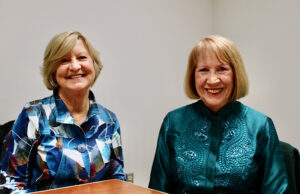
Salluzzo, 75, is a member of the board of the Finger Lakes Opera, which is beginning a banner year with growth prospects aplenty. A retired librarian, she sees evidence that Rochester is a very music-oriented community. “Opera is of interest to more people here than in some communities,” she said.
Sherry Marche, 73, partners with Salluzzo to co-lead the new and growing Friends of the Finger Lakes Opera group that exists to support the music. A psychologist, she’s watched how a singer can use opera’s power to affect listeners, especially kids, whom the FLO targets to develop an early interest.
“Kids get emotionally involved with the music and the story and the acting,” Marche said. “A musical will do that, particularly an opera, whose whole reason is to bring about emotions in a comical way or serious way. Opera is extraordinary with young students and is a great way for them to feel music and to be part of it. That’s so important.”
“The FLO is the professional opera company of Rochester,” she added. “Rochester is a gem. It has wonderful jewels that it gives people who live here and one of those is opera. Opera makes Rochester beautiful. Sharon says our community is special because it embraces the arts, theater and music and ballet and opera. We need to keep all those strong.”
The FLO gave its first concert in 2013 and for four years operated under the auspices of SUNY Geneseo. In 2017, the FLO began operating as a nonprofit on its own and produced two performances of Puccini’s “Tosca.” Last year, the FLO presented 40 programs, and more than 75% of those were free, bringing opera to the community and especially schools.
Working to increase its base and recognition not only in the Rochester area but nationally as an independent opera, the FLO developed a young artist program to give rising singers a chance to learn and perform.
That program had 80 applicants in 2018.
Last year there were 780 applicants.
Somebody’s noticing what’s happening in Rochester.
As it has grown, the FLO’s financial needs have increased.
The Friends of the FLO, organized a year and a half ago, is doing a lot and thinking about doing more. Its members volunteer at events and performances, provide transportation for young artists, host luncheons and receptions, support office staff and provide financial support. In turn, Friends of the FLO has the opportunity to meet all the artists, attend rehearsals, take backstage tours and social events and get discounts on tickets.
What the Friends do is enrich the experience of everyone associated with the FLO, which is prepared to make a splash in 2026.
What you’ll see on the Panara Stage at Rochester Institute of Technology in 2026 is “Glory Denied,” an opera written by Tom Cipullo; and Mozart’s “Marriage of Figaro.”
“We will also partner with the Glimmerglass Festival and Opera Saratoga for Kurt Weill’s Happy End, a pack-and-play production to increase awareness of opera throughout Upstate New York,” said Salluzzo. “Our summer festival includes Juneteenth, a program that illustrates the joy, resilience and journey toward freedom, justice and equality for all.”
That’s a mixture of classic comedic opera (“Figaro”), Weill’s gritty social satire of American capitalism and a gut-wrenching true story of prisoner of war jailed for nine years in Vietnam (“Glory”).
“’Glory Denied’ is very special,” said Rosie Kearin, the media and young artists manager. “Our artistic director was thinking about the 250th anniversary of our country and we should be doing something. This opera is about the longest-held POW, Jim Thompson. By the time he was released, his wife had moved on with her life. It’s not a happy-ending story. We are partnering with the Veterans Outreach Center for this. We will have counselors there if anyone feels a need to speak with a counselor.”
The Friends are thinking about getting involved in fundraising. The budget for the operations has more than quadrupled in six years. The FLO is hot!
“We’ve grown exponentially,” Kearin said. “We hope as the group grows, it will begin doing some of our fundraising or helping with it. They’re new, so we’re just establishing the volunteer part of that program. Eventually, I think they will probably start finding ads for our program and that sort of fundraising. We do rely a great deal on our grants, through the National Endowment of Arts, for instance. Ferris Foundation is very generous. We also have ads in our summer festival program that bring in some revenue.”
A lot goes into using and developing talent.
FLO will have from one to six top-level voices available in its season. “We bring in professionals who have worked all over the world,” Kearin said. Jazmine Saunders, who sang Gilda in the FLO’s production of “Rigoletto” last year, came from singing Clara in “Porgy and Bess” at the Metropolitan.
The second line of vocal talent are studio artists who are working toward becoming stars. “They are on the cusp of breaking through,” Kearin said. “They get paid and they apply to come join us for the summer. Those who are chosen get weekly coaching, have housing provided, get a weekly stipend and stay for five to six weeks in the summer and another two to three weeks in the fall.
A third group of voices, the apprentice artists, are local. “They have to have housing within driveable distance for the summer,” Kearin said. “They are skilled undergrads of the Eastman School or Nazareth University or recent graduates, or those who live locally but go to school out of the area, the Crane School at Potsdam State, for example. They could come from any school in the country and be living here with their family for the summer.” The FLO received 780 applications for 12 spots in the studio and apprentice groups.
The FLO’s autumn season brings opera sings to schools and other hosting venues. Within 19 days last fall, the group did 17 outreach performances. Some 14 Rochester schools got to see opera singers up close and personal.
“We’ve been having more schools call us,” said Salluzzo. “And the schools where we performed last year are calling us and saying, ‘We want you back. We want you here again.’ Children today have a very limited opportunity to hear a wide range of music. People are rediscovering opera. We need to engage with young people to show what opera is, the story with a human voice, which is an incredible musical instrument.”
“Kids get emotionally involved with the music and the story and the acting,” Marche said. “A musical will do that, particularly operas, their whole reason is to bring about emotions. It’s a great way for them to feel music and to be part of it. At the elementary level, that’s so important.”
“That human connection is so incredibly powerful, it’s why people wait for the performers afterwards to congratulate them because you feel that you know them,” Salluzzo said. “One reason it’s so important to take opera into schools is to create that human bond.”
In the winter, the singers visit senior centers and senior communities. The apprentice singers get experience in front of audiences. “It gives them some experience, which they need to grow and graduate, to fill out their resumes. They’re here, and they’re ready,” Salluzzo said.
“As Friends of the FLO, we see our function as representative servers, ambassadors. We were at the Panera Theatre last year and we’ll be back there this year,” Salluzzo said. “Before that, we kind of bounced around. Now people know where we’re going to be.
“We want opera to be more than just one generation; we want it to be many generations. That’s why we’re starting in the schools. That’s why we’re having meets-and-greets at the art gallery. We want people from all generations to see how beautiful opera is.”