
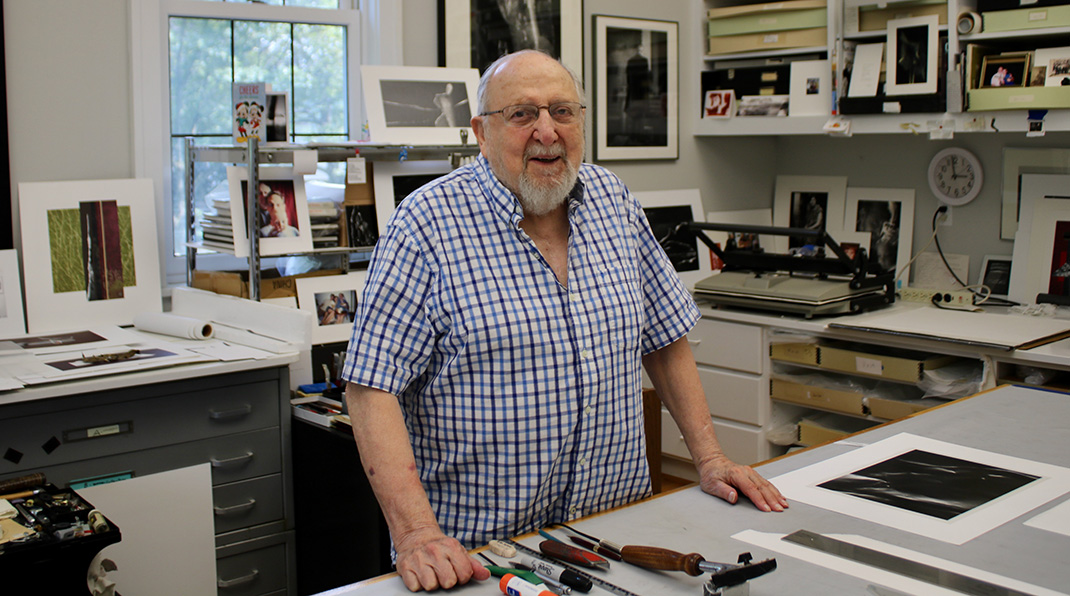
Carl Chiarenza Invites You to His Vision
He is an internationally renowned photographer, professor, critic, author, technician, musician, a Rochester treasure
By John Addyman
Have you ever painted a porch?
Or a wall?
Maybe a fence?
When you’re done, you look over the new surface with a trained, experienced eye: it’s your work. You know all its flaws. You know how you spilled over a line, where you dropped some extra paint…where you missed an infinitesimally small spot.
You figure, “I’m the only one who knows where that spot is.”
Because you’ve gone over every square inch, every millimeter of your project, for a proper length of time. The finished product is personal to you. Other folks will always enjoy it a little differently. And that was your purpose — to make something satisfying.
When Carl Chiarenza started his studies in the new photography program at Rochester Institute of Technology in 1954, he had class with prominent photographer Minor White, who taught his students the “Zone” approach to understanding and enjoying an image — gazing and intently studying that image for a solid hour, “looking at every silver halide molecule,” Chiarenza recalled.
The result: nobody knew that image like you did. And every person who did the same zone process would come to the same discovery: “Nobody knows that image like I do.”
Nobody.
And everybody.
Carl Chirenza, 90, is a master photographer, professor, critic, author, technician, musician and a Rochester treasure.
He has stepped away from many talented photographer brothers and sisters to make images that are singularly his.
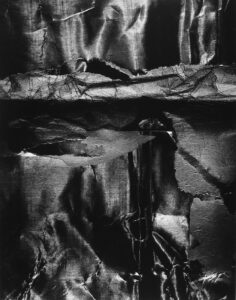
His works are in black and white, providing abstract photos that don’t look like anything else at first glance…but as the viewer spends time with the image, things emerge. Chiarenza’s preparation is so intimate, so deep, that you need a little time and space to get at his level, that zone.
“Photography and the making of images is communal,” he said at his Brighton kitchen table in August, with a backdrop of the beautiful back yard his landscape architect wife, Heidi Katz, designed for the couple, married 41 years.
“A picture is everybody; everybody has a camera and they photograph each other in their neighborhoods; they photograph their kids and vacations. You can’t go anywhere without someone putting an image on their phones,” he said.
The making of photos is a universal experience.
A long time ago, this Rochester Goodman Street kid was learning about photography from a playground leader who had a closet-turned-darkroom where kids could process their film. Chiarenza went from a Kodak Brownie to a German-made Kodak Retina camera in his youth, developing film in the attic and rinsing it in the second-floor bathroom.
One day, when he left the sink running and took off across the street to play with kids in the park, he came home to an angry father and water dripping from the ceiling in the living room.
Whoops.
At RIT, Chiarenza pursued a degree in fine arts, with classmates Bruce Davidson, Peter Turner, Jerry Uelsmann and Kenneth Josephson, who all became renowned photographers.
Chiarenza figured he’d grab the degree and go to work for Kodak. But he ended up getting his master’s degree from Boston University and broke away from the herd with a Ph.D. from Harvard in the art history of photography, the first in America. Chiarenza couldn’t help but blaze a trail.
He taught art history and photographic history at Boston University for 25 years, then spent 20 years at the University of Rochester doing the same. He was one of the few professors in the country with that kind of syllabus and he drew interest from outdoor photographer Ansel Adams of Yosemite fame and inventor Edwin Land, who developed the Polaroid cameras and film.
Chiarenza lectured and held workshops for students and photographers at more than 100 institutions all over the country. He wrote essays. His doctoral dissertation at Harvard centered on Aaron Siskind, whose images were similar to what Chiarenza was producing. The dissertation was initially resisted at Harvard because Siskind was still alive. Finally accepted, it became Chiarenza’s book: “Aaron Siskind – Pleasures and Terrors.”
Along the way, Chiarenza developed a reputation as an acute critic of photography books and published more than 100 reviews.
But his photographic art, detailed and precise, got started in a project with Ansel Adams, who would go on to create images at Yosemite that will have an impact for centuries. The two also got involved with Edwin Land and his experimental films still in development, experimenting with Land’s 20-by-24-inch studio camera in 1979. The camera was so big, you didn’t take it out to make pictures, you brought things to the camera.
Chiarenza was thrilled to use the new technology.
“I spent a week using a lot of their film, which I didn’t have to pay for,” he said. In the process, two things settled in him — he wasn’t really great with color photography, and while the big camera was fun, his work was getting smaller and more detailed.
His process focused on using Polaroid’s 55PN large-format film in a view camera like a Graphlex 2 ¼ x 3 ¼ or 4-by-5. Such large formats allowed for fantastic detail, such as would have made old professor Minor White happy.
Now hitting his stride, Chiarenza worked a routine in his art. He started his day with coffee, selecting music for background (mostly Mozart) and getting little things done in the studio before addressing the waiting camera and darkroom. His love for jazz was also part of the environment. He played clarinet and saxophone in the Johnny Matt Band in Rochester when he wasn’t making photos. He also sang in choirs throughout the area.
In his studio, Chiarenza would next concentrate for hours on arranging pieces of paper, parts of old photographs, flat-plane ephemera. He’d position the materials into a format that spoke to him.
“I liked what I saw,” he said. “It fit in that frame. It came together as a finished product. There was nothing white at the edges to pull people out of the picture. You don’t want to have white things at the edges.”
The 55PN film would give him a positive image with amazing sharpness and here’s a Kodak plug — “Panatomic X Quality” — detail and depth. Under the camera stand, he moved the lighting around, adding and subtracting what was lit, having the shadows from the paper add interest. He says it’s very important “to follow the light.”
When he found the perfect positive image and that might be 10 or more photos, — he’d go into the darkroom and process the negative portion of the 55PN film and making his prints, doing all the tricks that any darkroom master would use.
Chiarenza’s assembled collections and published books are detailed on his website (www.CarlChiarenza.com) and you can watch a video interview made by his daughter, Gabriella.
“Making a photo is time-significant, referring to the zeitgeist,” he said. “The picture is part of the culture and community. Every generation refers to what came before. We can’t avoid that history. It comes from looking.”
In his art history classes, Professor Chiarenza started each semester with a discussion of prehistoric cave art, because that was the birth of all the images we have before us today.
Looking at a Chiarenza print, you learn, is a little like getting ready for a big event. You want to relax and as the artist advises, let the image come to you. And as Minor White would add, take your time.
Chiarenza has work on display all over the country. He’s been the star of 90 individual shows and participated with others in more than 200 exhibits.
“The Virginia Museum of Fine Arts has my full archive, one of every one of my pieces,” he said.
His wife adds that the museum is adding a photography wing. “That’s why they took his archive as part of their permanent collection,” she said. “If you wanted to study Carl’s work, you’d have the opportunity there.”
Chiarenza shut his studio down and backed out of most of the work he did when Polaroid stopped making the 55PN film. Now he occasionally does a collage, using some of the photo pieces that Katz saved for him…just in case.
He emphasizes quietly that he doesn’t and can’t interpret his work. What’s done is done and he was satisfied in the making.
“I hope people can see what it means to them…not to me,” he said.
‑