
Art Under Foot
Victor’s Oriental Rug Mart creates rugs inspired by famous artists
By Grace Scism
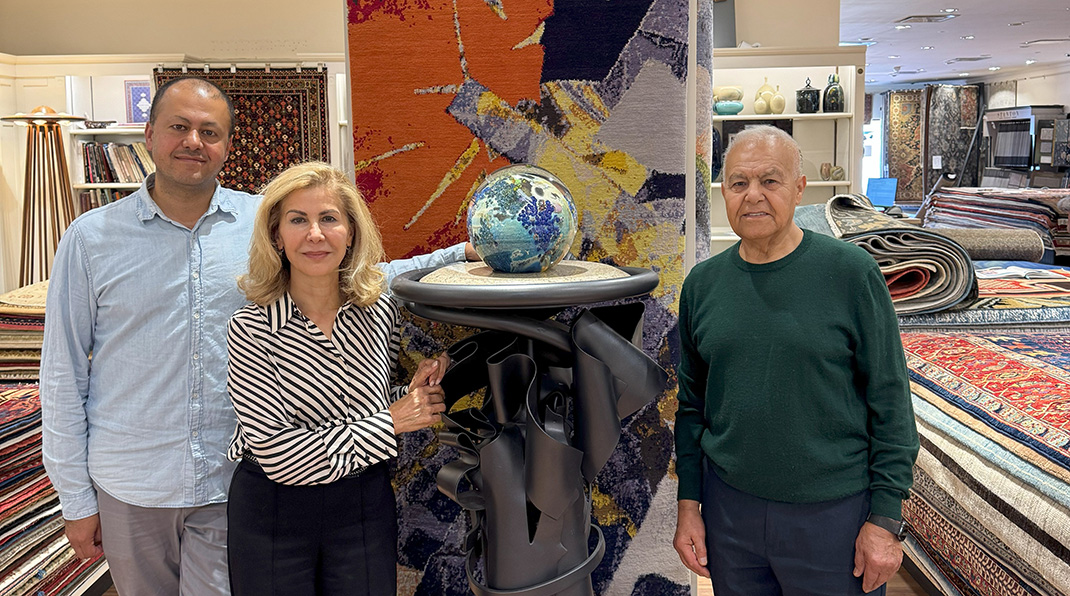
Reza Sattari was a young teen when he told his grandmother, whom he called Nane Fatomeh, that he wanted to design his own rug.
In his native Iran, weaving is a hobby much like needlepoint or knitting here in the United States and Fatomeh wanted to weave small rugs for her children and grandchildren.
Passionate about the game of chess, Sattari wanted his design to incorporate chess pieces. When he saw her many years later, Fatomeh, then 98, still had his original design that he had drawn on pieces from a wooden box.
“Nane Fatomeh, do you have the design I gave to you?” Sattari asked her. “She was sitting and drinking tea, then got her cane and went into the back room. Ten minutes later, she came up with the design I had given her so many years ago.”
Little did the young Sattari know that, eventually, bringing beautifully designed and woven oriental rugs to Rochester would become his life’s work.
Sattari first went into military service in Iran and taught people in the villages how to read and write. After studying economics in college, he became a distributor of Kodak products in Iran. With that and other connections, he and his wife, Jila Kalantari, eventually came to Rochester.
Once in Rochester, Sattari began selling oriental rugs with a partner before opening Oriental Rug Mart with Jila in 2007. The store has moved a couple of times over the years and is now located in Eastview Mall near Von Maur.
Their son, Hadi, who was studying mechanical engineering at the University at Buffalo, helped run a small rug store in Buffalo, which his family later bought. He now helps his parents manage their current store. His brother, Mehdi, studied medicine at the University of Rochester and is now an emergency room doctor in Northern California.
Art Interpreted
The work of French artist Paul Reynard was the spark for what would become Art Interpreted, the creation of hand-knotted wool rugs inspired by original artwork. Sattari knew the French painter, who taught at The School of Visual Arts in New York, through a group of friends.
Reynard died in 2005, but his legacy of richly-patterned art inspired Sattari to begin working with Reynard’s estate and navigating French copyright laws to create the first Art Interpreted rugs.
Sattari also had connections with Albert Paley, Rochester-based metal sculptor. “At some point, Albert saw the samples and some of the rugs that were made for Paul Reynard and said, ‘Reza, why don’t we make rugs together?” remembered Jila.
“Initially, Albert was skeptical of how we would take three-dimensional sculpture and make it into a rug,” said Hadi. “But then, we saw that there are monoprints of his work, which are two-dimensional, but have depth.”
The Sattaris began working with the third artist, Josh Simpson, when they saw his work while on vacation in Massachusetts and then at the Corning Museum of Glass. Simpson’s glass art is inspired by the beauty of the night sky and other astronomical phenomena.
“We finally did an official launch of Art Interpreted in May 2022 with a lecture series with Albert Paley and Josh Simpson,” said Hadi.
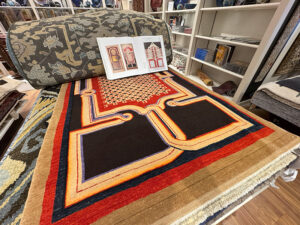
Brian Orner, the fourth artist to join, was initially involved in developing the process for transforming physical artwork into a form that could be rendered in wool, while retaining the impression of the original artwork.
“At that time, there was no reliable method of transforming the colors of a digital image into a similar or identical color in wool, especially when using natural vegetable dyes, which by nature are not perfectly color consistent,” said Orner, who now has 15 of his photographs interpreted as rugs.
Over the years, there has been much trial and error to perfect the process that has resulted in unique, world class rugs.
“A painter can, with watercolor, get 50 shades of blue with a drop of water, but when you’re dying wool, it’s tough to get all of those variations,” said Hadi. “So it’s a back and forth process with the artist and weaver to get it so that you can interpret the art into a rug efficiently.”
The rugs are woven of 100% wool pile with cotton backing and the artist’s signature is woven in silk. All of the Art Interpreted rugs are made in Nepal.
“They’re one of the countries, in terms of weaving capability, that can create really high-quality rugs that meet our standards,” said Hadi. “Also, the sheep live at higher altitudes and have longer coats, so you get different length staple fibers.”
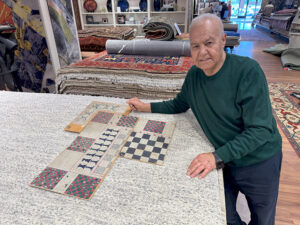
Each of the rugs from Nepal is based on a 12-by-12 grid in one square inch with 144 knots in each square. In making traditional rugs, a lot of the design is repeated so one doesn’t have to design the whole rug.
“But with abstract rugs, every knot is unique and in a different place,” explained Hadi. “So we created a system where you can scale up and down the size, but still do fidelity to the artwork and then be able to communicate to the weaver where to put the knots.”
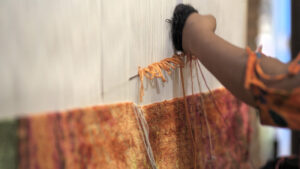
An 8-by-10 rug made by two weavers can take anywhere from six to eight months to weave. “Now before that, you have to spin the wool, dye the wool and set up the loom,” said Hadi.
Once the rug is finished, it is torched to remove loose fibers and give the rug a clean finish, thoroughly washed and packed. The full process can be viewed in a video at Artinterpreted.com
All of the rugs are limited edition and numbered. “So the artist gives us a limited edition number, for example Albert Paley is 50 and we can make up to that number in any custom size,” explained Hadi.
The prices average from $150 to $180 per square foot. Hadi said it’s been challenging planning pricing with the current changing tariffs. Oriental Rug Mart also sells many other rugs made in India and mass-produced machine-made rugs from different importers.
“We’re starting to see price increases that have hit us this month, that are hitting us next month and then items that we import directly from India have a 50% duty currently,” said Hadi.
The Marriage of Art and Function
Over the years, Oriental Rug Mart has become more than an oriental rug store. In fact, this past year, the business has incorporated artwork, sculptures and books by its four featured artists. Most recently, Oriental Rug Mart hosted docents from the Memorial Art Gallery.
“It was a nice chance for the docents to observe the art and hear someone else talk about it. And it was a great opportunity to showcase what we’ve been working on with Art Interpreted,” said Jila. “There’s not a lot of places in Rochester that have 30 or 40 of Albert Paley’s pieces and artwork from Josh Simpson, so it’s a nice collection we’ve put together.”
Oriental Rug Mart has also hosted art classes from local schools.
The Sattari’s ability to interpret other art forms using the traditions and techniques of the rug-making world, dedication and extraordinary attention to detail can be observed — and felt — in their Art Interpreted rugs.
“So this art is really my life,” said the senior Sattari. “And I enjoy every single minute of it.”
The Artists
Paul Reynard was born in Lyon, France in 1927. In the mid-1950s, in collaboration with architects, designers and craftspeople, Reynard designed and installed the stained glass windows in the rebuilt Church of St. Rémy in Baccarat. He subsequently created stained glass windows in churches throughout France and exhibited his paintings in Lyon and Paris.
In 1968, Reynard moved to New York where his focus was painting. During the next 30 years, he designed and painted numerous murals, and his paintings, banners and drawings were shown around the U.S. and Canada. During this time, he taught drawing at the Parsons School of Design, Pratt Institute and finally at The School of Visual Arts where he worked until his retirement in 2002.
From 2003 until shortly before his death in the fall of 2005, Reynard worked closely with the editors of the book about his work in the United States, Paul Reynard: Works in America.
Albert Paley, born in 1944 in Philadelphia, Pennsylvania, is an American modernist metal sculptor. Initially starting out as a jeweler, Paley has become one of the most distinguished and influential metalsmiths in the world. Paley is the first metal sculptor to have received the Lifetime Achievement Award from the American Institute of Architects. He lives and works in Rochester with his wife, Frances.
Paley earned his Bachelor of Fine Arts in sculpting with a minor in metalsmithing from Tyler School of Art and later earned his Master of Fine Arts in goldsmithing.
Paley moved to Rochester in 1969 to teach at the Rochester Institute of Technology, where he now holds an endowed chair. In 1972, he decided to focus solely on his own work and has received numerous awards. Paley’s sculptures and metal gates are on display throughout the U.S., including the famous Portal Gates at the Smithsonian’s Renwick Gallery.
Josh Simpson, born in New Haven, Connecticut, in 1949, is an American glass artist. His work has been exhibited in numerous galleries around the world and is displayed in museums such as the Corning Museum of Glass; the Museum of Fine Arts, Boston; and the Renwick Gallery.
Simpson’s career began in 1972, when he was a senior at Hamilton College and became enamored with glass after practicing glass blowing in Vermont. Simpson is well known for his planets, glass paperweights ranging in size from about an inch in diameter to the 107-pound Megaplanet the Corning Museum of Glass commissioned in 2005.
Married to former astronaut Catherine Coleman, Simpson’s Infinity Project invites people around the world to hide his glass planets so others may find them. His studio is located in the rural hills of Western Massachusetts, in a converted dairy barn beside his home.
Charles Brian Orner, born in Gettysburg, Pennsylvania, is an author, designer, photographer, and marketer. More than 10 years ago, he began working on and off for Oriental Rug Mart, first as a contractor, assisting with marketing, inventory management and a bit of sales. He later became a full-time employee after the business moved to its Eastview Mall location and has been instrumental in developing and perfecting the process for transforming physical artwork into a form that could be rendered into wool, while retaining the impression of the artwork.
Orner’s website, charlesbrianorner.com, features his photography, drawings, paintings and books. He lives with his wife and daughter in Fairport.