
A Peek Behind the Scenes
Brighton resident’s memoir depicts the 25 years he spent in television production, including at the popular ‘Lifestyles of the Rich and Famous’
By Mike Costanza
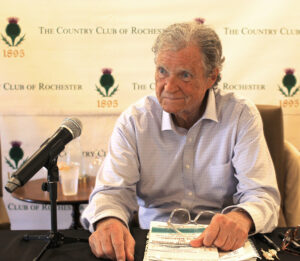
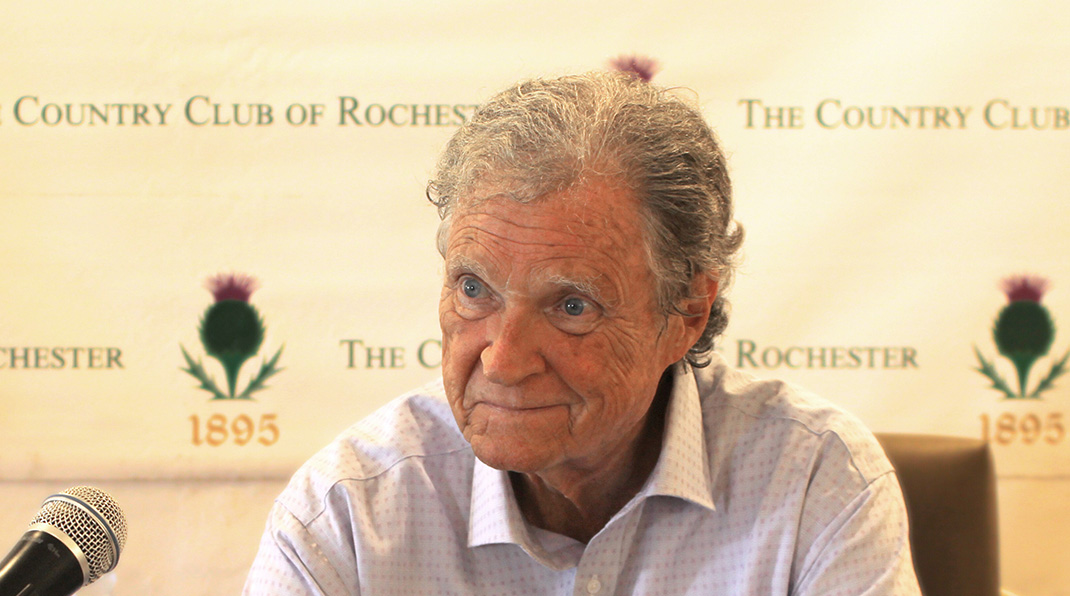
Jim Cross marvels at the breaks that he received during his long career in sports and entertainment television.
“I was a very lucky guy in the television business,” the 78-year-old Brighton resident said.
“Champagne Wishes and Caviar Dreams: The Television Journey of a Lifetime,” which Cross co-wrote with his longtime friend, Jim Millman, details the decades he spent helping to create about 1,000 sports and entertainment television shows.
“It’s a thank you note for all the people who helped me along the way and it’s also a chronicle of my working life for my grandchildren,” Cross said.
His work took him behind the scenes at major sporting events like the 1972 Summer Olympics and hit reality shows, including “Lifestyles of the Rich and Famous.”
His career path took him to 24 countries and allowed him to meet pro hockey player Phil Esposito, actress Morgan Fairchild and others who made their mark in sports or show business.
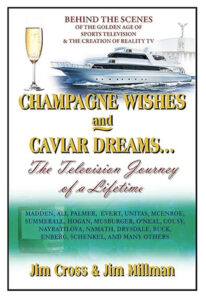 Cross even helped bring a New York City real estate developer named Donald Trump to television audiences long before he came to star in “The Apprentice” or be elected president of the United States. He drew the title of his memoir from “champaign wishes and caviar dreams,” the catchphrase that Robin Leach, the first host of “Lifestyles” used to sign off.
Cross was born and raised in Fairport and entered Ithaca College on a basketball scholarship. Choosing a major was fairly easy.
“I majored in radio and television simply because there was no math or language requirement,” he said.
After graduating from college in 1969, he took a job doing television production work for the now-defunct firm TVMI. The New York-based company, which was founded by Lou Tyrrell and Marvin Sugarman, created and distributed closed circuit television programs on medical and business subjects.
Cross eventually became TVMI’s sales director, but after seven years realized that the market for its productions was drying up. Tyrrel and Sugarman were producing a show for CBS, “AAU International Champions,” which featured competitions among young athletes. Seeing an opportunity, Cross approached Tyrrell.
“I said, ‘Listen, I want to learn the business. I’ll work for you and I’d like to get on this show and I’ll do it for nothing,’” Cross said.
He got the unpaid position, but had to find his own way to California, where the show was shooting. The show’s technical director planned to drive his new, two-seat Mercedes convertible to the site, but already had someone in the passenger seat. Cross convinced him to take another passenger west.
“I rode in the boot of the two-seat car from Philadelphia to Modesto, California,” Cross said.
For about the next five-and-a-half months, Cross traveled to track and field meets all around the US and the world.
“I was a gofer, production assistant, do-anything cable-puller,” he said.
Cable-pullers controlled the cables that ran from the handheld television cameras to the broadcast truck.
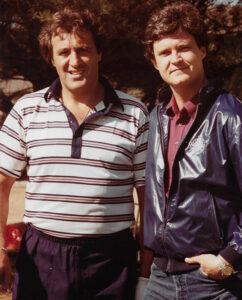
“I was holding onto the cable and I was making it possible for the cameraman to go left-to-right, forward-to-backwards. I would pull the cable for him,” Cross said.
The unpaid gig was Cross’s entry into sports television and he was eventually hired as a freelance associate director by ABC Sports, which was covering the 1972 Summer Olympics in Munich, Germany. One of his jobs was to edit footage for a primetime preview show on the games. Jim Millman, who was a freelance production assistant for ABC Sports, worked alongside him in the editing room.
“He was very talented at video editing and particularly laying music to sports highlights,” said Millman, who counts Cross as a friend. “He wanted things to be perfect.”
The editing work gave Cross his first big break. While working on a piece on javelin throwing, he also recorded a video of the 10,000-meter race, wondering how the Finnish runner, Lasse Virén, would fare.
“I had done a show about three weeks earlier where Lasse Virén, who was the world record holder in the 10,000, fell or was pushed down and got up to win the race,” Cross said.
Virén fell in the 10,000-meter race, recovered and went on to take the gold medal. Unfortunately, the show’s director had already ceased recording the race. Chuck Howard, the senior producer, frantically called around for a clip of Virén’s win and Cross tendered his footage of the event. Howard subsequently showed his gratitude by assigning him to help cover college football games in Texas and Hawaii and an auto race and even offered him a coveted full-time job as an associate director for ABC Sports. Cross was also nominated for an Emmy Award for his work on the network’s coverage of the Munich games.
Cross was lucky in another way while working on the Summer Olympics. In what became known as the Munich Massacre, eight heavily armed terrorists from Black September, an extremist faction of the Palestinian Liberation Organization, entered the Olympic complex.
When Cross and his co-workers left the building in which they’d been working, the terrorists were hiding behind a nearby dumpster.
“The dumpster was probably about 25 feet from us,” he said. “They could have wiped us out.”
The terrorists killed two members of the Israeli team and took nine others hostage in an effort to win the freedom of hundreds of Arab prisoners who were in Israeli jails. When the crisis was over, all the hostages, one West German police officer and five of the terrorists were dead.
Cross helped cover the hostage crisis for ABC, but that wasn’t the highlight of his time in Munich.
“The highlight was recording Lasse Virén falling down,” he said. “It made my career.”
Though Cross took the assignments that Howard offered, he turned down the full-time job with ABC Sports.
“He [Howard] said, ‘You’ll have to be an associate director for at least a year before I can upgrade you to a director.’ I didn’t want to wait that year,” Cross said.
Another break came his way when he was assigned to direct CBS’s coverage of the 1974 NFL game between the New York Giants’ and the New England Patriots at the Yale Bowl in New Haven, Connecticut. The job required him to direct the show from a broadcast truck.
“I had no idea what I was doing,” Cross said. “I’d never worked in a truck.”
The show’s technical director took pity on him and directed the show while Cross watched.
“That’s how I did my first NFL game,” Cross said. “Then, I went on to do almost 100 more.”
His work as a freelance director on shows about NFL games eventually earned him his second Emmy nomination.
Altogether, Cross spent about 13 years helping to present sports events to the viewing public. During that time, Millman hired him to work on as many as eight productions for Millsport, the sports marketing agency that he’d started a few years after the Munich games.
“One of our favorites was the Pepsi All-Star Softball Game, which ran for many years on NBC Sports,” Millman said. “That was major league all-star players playing softball against each other.”
Millsport is no more, but Millman is the founder and CEO of Incuvate LLC, which provides sports venture development and marketing consultation services.
In 1983, Cross was asked to look over the pilot for a new show that the legendary television producer Alfred Masini was trying to get off the ground, “Lifestyles of the Rich and Famous.” The show was supposed to depict in graphic detail the glamorous lives and opulent residences of its very wealthy subjects, but its pilot was, as Cross put it, “terrible.” Masini hired him to redo it, was satisfied with the result, and had him put together the show’s second pilot.
“In the old days, you did two pilots,” Cross said. “If you did a good second pilot, you started the series.”
Trump was featured in one of the second pilot’s segments.
“He was very personable,” Cross said. “When he talked to you, you were like the only person in the room.”
The second pilot clinched it for “Lifestyles” and ABC telecasted the show from 1984 to 1995. For all but the last year of its run, Cross directed, edited and produced each episode.
“We had six or seven segment directors,” he said. “They would go out and do a five-minute piece and they would send to me and I would reshape it and put it into the show.”
The job, his first full-time position in television production, gave him the chance to earn his third Emmy nomination. While working on “Lifestyles,” Cross also consulted on about 12 other shows that Masini and his company, TeleRep, created, including “Fame, Fortune and Romance,” a short-lived daytime “Lifestyles” spinoff that Leach co-hosted.
For Cross, the best part of working on Masini’s shows was that he didn’t have to spend weekends at sports events and could watch his two boys grow up. He retired at the age of 47 in 1994.
“I was in good health. I was fairly financially secure,” Cross said. “My dad, who had worked all his life, lived six months after he retired and died. I said, ‘That’s not going to happen to me.’”
After he retired, Cross and his wife, Hildye, traveled to Australia, China and other far-flung parts of the world. He used to play golf at the Country Club of Rochester, where he is a member, but now spends his time there socializing with his friends.
“I am 55 seconds from the time I open my door until I get into the pub,” Cross said.
Pat Burke, a longtime friend who regularly meets Cross at the club, said he likes listening to his stories about working in sports television and loved “Champagne Wishes.”
“It allows you to think about an event that you watched on TV and then be told about how it actually transpired,” the 64-year-old Rochester resident said.
In addition to sharing stories with his friends, Cross enjoys spending time with Hildye, his wife of 58 years, and with his sons and five grandchildren.
“Champagne Wishes and Caviar Dreams: The Television Journey of a Lifetime” is on sale online from Amazon and Barnes and Noble.