
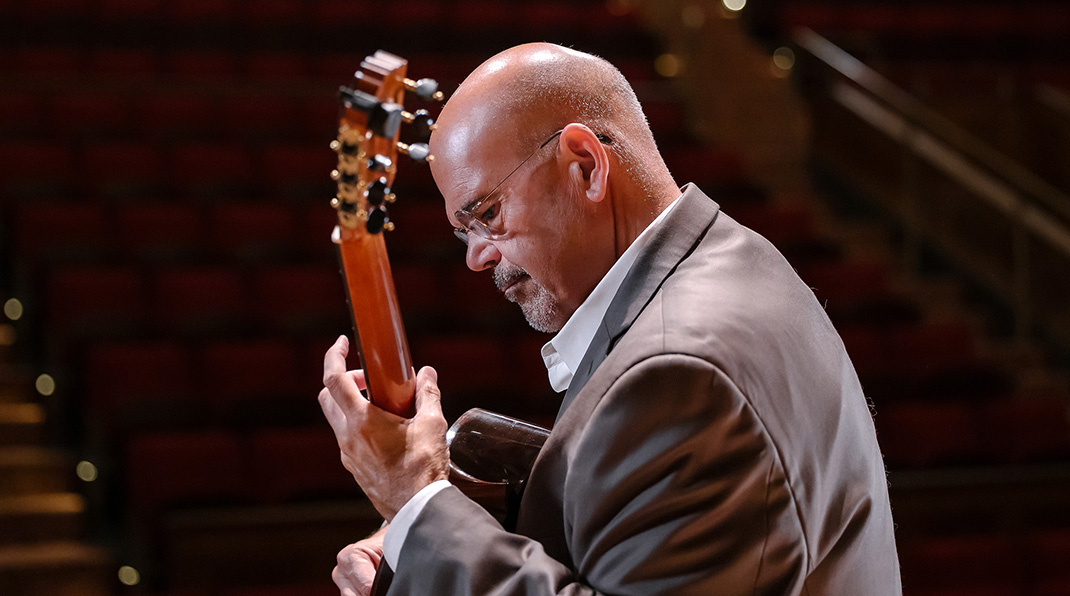
Guitar Virtuoso: Nicholas Goluses
With the release of his 10th album late last year, Rochester guitarist Nicholas Goluses continues to expand his influence in the music world.
By John Addyman
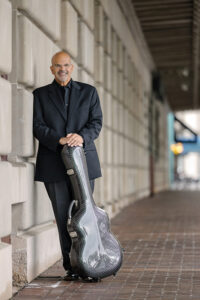
“It’s a triple career,” Nicholas Goluses said.
He is comfortable in his office at the Eastman School of Music. On one wall are photos of his idol, Spanish classical guitarist Andres Segovia. Another wall is adorned with copies of CDs Goluses has recorded, his 10th one released last fall.
Behind him is a wall of manuscripts and LP records and books. There are two turntables in the room and a quality stereo system.
There’s also a grand piano and four benches, with room enough for the professor, founder of the Guitar School at Eastman, to sit with his students. He’s been teaching, playing concerts and practicing here for 32 years. As relaxed as the office is, there’s an air of quiet accomplishment, of confidence and knowing.
You’re in the sanctum of someone very special.
Eastman students can expect that triple career.
“First,” the maestro explained, “it’s playing concerts and everything we do to get ready, technically, musically, to play the repertoire.
“Second, we make recordings and everything involved with that.
“Third, we teach. We all have sister careers as teachers. All of us are teachers.
“All of us are performing. We do the three things and each one enhances the other — the more you practice, the more your teaching has depth. In your recordings, you must be perfect. It just has to be. You don’t put out a recording with a lot of mistakes. So that drives the level up — you have to become more efficient, more consistent. It’s a triple career.
“And something I help my students apply to and get — college teaching. Some of them teach in community colleges, some in secondary schools, but they’re all teaching. Two of the deans here at Eastman School of Music are my former students.”
Eastman celebrated Goluses’ 70th birthday in April 2025 with a special concert, with the world-renowned Ying String Quartet (Eastman’s quartet-in-residence) performing.
He travels extensively — he does 25 concerts a year (half outside the US), is an examiner for Ph.D. dissertations in guitar in England, Ireland and Scotland and has a Fulbright residency in Ibaque, Columbia.
All that travel and his two new hips recently caused a stir at an airport.
“Yes, it was tricky at the airport. I got my new hips six months ago,” he said in January. “I flew from North Carolina the day before yesterday and I set off every imaginable bell and whistle for security. I told them, ‘I have titanium in my hips.’ We had all the wands and the pat-downs and everything going on.”
Raised in Rhode Island, schooled at the Manhattan School of Music where he earned a Doctor of Musical Arts degree, Goluses has given concerts all over the world. He has been the first performer of more than 100 compositions and he calls many composers friends.
“It’s an incredibly enriching experience, working with composers,” he said. “They just think differently than we think. Some are very, very flexible. They write something and they don’t know guitar and you show them how it needs to be modified — sometimes they are very happy to modify; sometimes they say, ‘Well, if you practice a little more…’”
The guitar that rests in a special ballistic case on a side table in his office was made 20 years ago by Matthias Dammann of Passau, Germany.
“A guitar is not a loud instrument unless you amplify it,” he explained. “But people don’t want to hear it through a speaker, they want to hear the instrument and that requires a technique to be developed.
“Segovia had a mission statement. Before him there really was no opportunity for a classical guitarist to play on concert stages — the guitar was more of a ‘salon’ instrument. Segovia changed all that. His mission was to one develop the repertoire [of guitar music] by non-guitarist composers. He got some of the finest composers to write for him. Two, to develop the technique so the guitar could be heard on large concert stages. He did that. And three, to see that the guitar gets established in the world’s greatest conservatories and universities. He achieved all three by sheer will, determination and a big personality.”
It all started with the Ed Sullivan Show
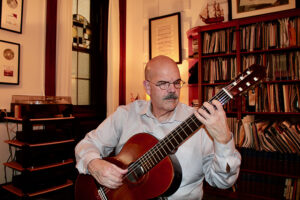
Goluses took the guitar out of the case and played something for a few minutes. No tuning. No preliminaries. Just solid, beautiful tones. Wow.
Maestro-level performer. Master teacher. Recognized the world over. He’s been a voter for the Grammy Awards since 2012.
How did all this get started? He explains… “I remember seeing the Beatles on the ‘Ed Sullivan Show’ when I was a kid. I thought that was the greatest thing. So, I badgered my father for an electric guitar and he got me one. I started a little band, a rock band. We were very popular. We were playing at all of the school dances and everything else.
“A couple of years later, again on the ‘Ed Sullivan Show’, I saw Andres Segovia. I was very moved. I said to my father, ‘Who’s that?’
“He said, ‘Well, that’s a real musician.’
“I said, ‘Oh.’ The gauntlet had been thrown down. I started classic guitar and never looked back. That was sometime in ninth or 10th grade.
“Years later I studied with Segovia and spent time with him. I had invited him to come give a master class to my students at Manhattan School in 1982 and I also had a chance to have some private lessons with him. I was in the early stages of my career and he was very helpful. He took that sound he had to the grave. He had a real vision of beauty, sonically…like nobody’s been able to do. The last time I played for him was 1987.”
In 1993, Goluses was teaching at Manhattan School of Music and the job opened at Eastman.
The stay in New York City was great. Goluses had been asked to join the faculty at Manhattan School and had been there for years.
“I loved it there,” he said. “Eastman had never had a guitar program and decided they wanted to start one. I got offered the job. I came up here and I was so enamored with the school, the people, especially. I had two small children at the time and it was the right thing to do — to come up here, raise them and start a guitar program.
“It turned out to be just a joyful 32 years. It’s been a pleasure on every level, artistically, lifelong friends that I’ve met and love. I’m an avid sailor. There’s a lot of water up here…beguilingly beautiful water for sailing; hence, the title of my newest CD, ‘Across the Horizon.’”
Grooming the New Generation of Musicians
A student stopped by his office on an afternoon in January, wanting to play his upcoming concert for his professor and looking for advice as he left the office.
“Drive carefully and dress warmly,” Goluses told his master’s degree student.
The maestro is a 6 a.m. riser and walker, doing a three-mile lap that includes a stop at the Eastman House on his route, no matter the weather.
“Then I have practice for two hours and do technique,” he explained. “I warm my fingers up for the day. Musicians are athletes of the small muscles.
“I know that when I start teaching each day, I want to be able to give everything I can to my students. I need to feel settled musically and prepared when I see them. These are really good students, some of the world’s best young virtuosi. I like being the old dog, but they’re a handful. Staying a step ahead of them takes a little preparation. I love that. Keeps me young.”
At the end of his teaching day, Goluses walks home for dinner, then comes back to attend recitals and concerts, supporting the students he sees in class. He has a full life.
“I’d be happy to get another 10 years,” he said. “I will never stop, as long as I’m physically able. At age 96, Casals was asked, ‘Maestro, you’re still practicing every day. Why?’ ‘I keep making progress,’ Casals replied. Andres Segovia, the Spanish cellist, said at his last concert, ‘I’ll have eternity to rest.’”
“I will never stop,” Goluses added. “I’m physically addicted to this. It gives me more joy than anything. I hope to live for a long time and my new hips are helping me. There are two things we do well in Rochester — medicine and music.”
First Solo Album Released in 1995
“Memento Bittersweet” was the first album he made.
“It was a recording by a number of artists and composers — and all the composers had died of AIDS. I did a piece for organ and guitar called ‘God is our Righteousness.’ It’s a gorgeous piece. Christopher DiBlasio had written it right after he was diagnosed HIV positive, which in 1991 was a death sentence. I’m proud of that record. I’m proud of what it stands for. I remember Chris very well: he was a special guy. He showed how you can write something extremely positive in the face of physical discomfort,” he said. “It’s the will to do the work to make it beautiful in the face of adversity.”
Goluses first solo album was released in 1995, “Bach Sonatas” on the Naxos label. He’s recorded on the Linn, BMG and Nueva Venecia records and “Across the Horizon” is on the Albany label. On stage, he’s played concerto performances with many of the world’s great orchestras. He’s received special awards, accolades and recognitions at Manhattan and Eastman. And to his utter delight, many of his students have won major awards all over the world.