
Poppy Roesch and Her ‘Magic Dragon
The woman who guides the ‘Magic Dragon’ to help young writers and artists fly
By John Addyman
Way too late in my life, I went back to teaching school, something I hadn’t done in 45 years.
Very early in that first school year, we had a special drill — something my kids were all accustomed to, but something I’d never experienced — a lockdown, shooter-in-the-building drill.
My little school had precious few safety measures in place, including the fact that to lock my classroom door, I had to go out into the hall. I couldn’t lock it from inside.
With my eighth graders, we practiced quickly moving a big heavy lab desk across the closed door.
Then one of my kids asked, “What happens if the shooter is able to push open the door?”
“Well, then he has to get through me before he gets to you and I won’t let that happen,” I told my kids. I was dead serious and they knew it. I’ve never seen looks on kids’ faces like that moment.
The point I’m making is that kids are different today, so very much different. They are walking around with a burden too few of us actually see.
When my dear wife and I were in school, we did “duck and cover” drills, diving under our desks to prevent serious injury from atomic bombs falling from Russian planes.
Those fears, though real, were nothing compared to what children today feel: fear from COVID-19 and measles, fear from shooters in their schools, fear from ICE coming to get them at home or school or walking from a school bus, fear about family members and friends disappearing and deported, fear of a friend’s life taken by drugs. They see these things on social media and TV every day.
And this has left a mark on the souls of today’s kids.
Patricia Roesch knows.
“Their writing is very creative, very unusual,” she said. “Sometimes they write about family matters — grandmother leaving — ‘We only see her once a year.’ It’s clear to see now that kids are writing about things they’re afraid of. And things that are bothering them. Kids write about the uncertainty of their lives right now. You see that in their writing. You see that in their poems. It’s fairly clear.”
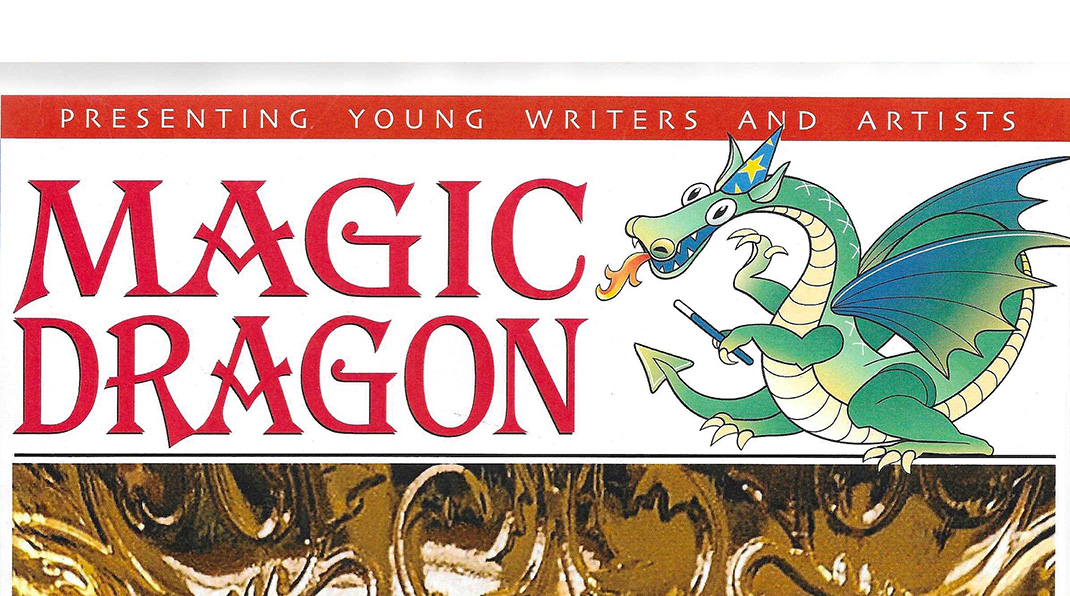
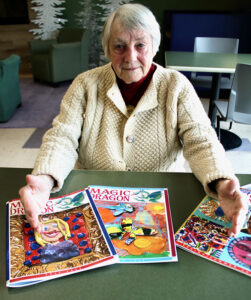
Roesch, known as “Poppy” by her friends and fans, is the creator and editor of the “Magic Dragon” magazine.
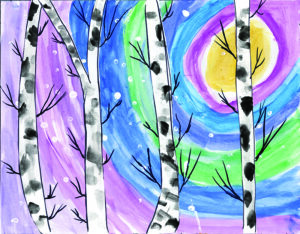
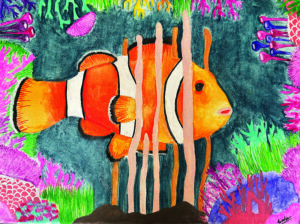
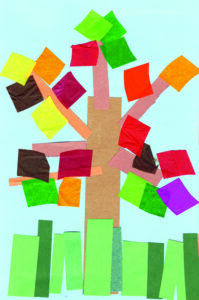
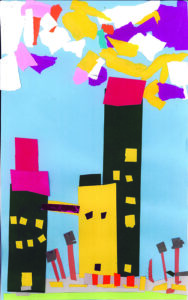
The blazingly colorful artwork, poems and stories in “Magic Dragon” are all submitted by children 8 to 12 years old and presented four times a year. Each issue highlights contributions from about 70 kids, many of whom are from the Rochester area, but could also be from Japan, Florida, Texas, Saudi Arabia, Maine, West Bengal, California or Tanzania.
Every child whose artwork or writing is used in the publication gets a free copy of that magazine, which is printed on heavy stock in vibrant colors.
“The kids just go nuts when they see their work in the magazine,” Roesch said. “They’re very pleased that they’re in the magazine and they show their friends.”
The 86-year-old Webster resident has an English degree from the University of Rochester and a master’s degree in journalism from Syracuse University. She worked as a writer and editor at the UofR,
“Then I proceeded to work in various places, doing various jobs, writing, photography, layout, the works. I worked at a medical society for a while doing things for them. The last thing I did was the manager of editorial services at the Xerox Webster Research Center. We were a publications group that edited and helped the scientists do their reports and their journal papers and articles and whatever else they needed help with. I was there for 17 years. It was a lot of fun. It was before the launch of the DocuTechs, so we were doing big important things.”
When the job at Xerox went away, Roesch kept busy doing freelance editing and proofreading of dissertations, theses and research papers at area colleges and universities.
Before all those years at Xerox, she had worked with a children’s magazine, “Kid Stuff,” which closed after the third issue in the 1970s. That little experience moved her.
“I loved that magazine, I thought it was a great idea,” she said. “I got a wonderful kick out of it. I said to myself, ‘I want to do this.’”
To get “Kid Stuff” off the ground, Roesch got all the legal paperwork together to form a nonprofit magazine. And after Xerox, she got started all over again in 2002. Three years after that, “Magic Dragon” was born with partner, artist, former teacher and creative genie Joanne Andrews performing wonders.
From the outset, Roesch and Andrews had a goal.
“’Magic Dragon’ is unique,” Roesch said. “Each child whose creative work appears in the magazine is recognized as a writer or artist. It is not a competition. There are no contests. The reason we publish it is to encourage children to be creative and to express themselves and not to be afraid to express themselves…to validate their ideas and thoughts that they’re important. We present a way to get them to express themselves without losing their way, without blowing something up or getting in a fight. Things have changed from 20 years ago, everywhere, especially among young children and education.
“We publish bad things, like somebody’s dog died and that was pretty sad and some things kids are frightened of, we do that. We don’t publish anything about guns or violence. Mean stuff. Kids have a lot of things to say.
“Good art teachers help a great deal,” Roesch continued. “Good art teachers can do miracles for kids. One of my teachers said the other day to one of her students, ‘Your picture is going to be in the ‘Magic Dragon.’ And the little girl was quite excited and said, ‘I want to be an artist when I grow up.’
“The teacher said, ‘You already are an artist.’ She was 8. ‘You’re an artist now.’ That’s exactly what we’re trying to do. You’re an artist. You’re a writer. Your feelings are important. If you don’t like bullies, that’s important. Even though you may only be 8 years old. Not all kids get that kind of support. No matter what their demographic is.”
With her over 20 years of carefully analyzing children’s writing for production, Roesch has seen the differences emerging in today’s young writers.
“I think the kids, what I’m noticing, the age of being young and innocent has lowered. We set the age as 12, that’s when you had middle schools. When we began, most young kids wrote about things that are solvable, they had a problem and solved it, which is the formula for writing a short story.
“We see more kids today who write about things that maybe are not solvable: it doesn’t work out by the end. They do the best they can — that’s how they finish up, getting the magic ring back to the right place. They do the best they can. There’s an undercurrent that’s saying to me how we all feel – uncertainty, some anxiety. We get writing from kids that’s about things they’re just worried about.
“That’s a popsicle stick compared to what some kids are going through. It’s terrible. So, we feel we are doing something good beyond just encouraging kids to paint a picture. We’re giving kids a way to explain how things make them feel. We’re giving them an opportunity to express themselves and be able to think they’re recognized — they’ve done something important — they had an idea and they painted it or wrote it out.”
She notes the many competitive outlets for kids. “That’s a safe thing to say about our society right now,” she believes, “there’s too much competition and not enough respect for those who are not competing — the artists and arts people.”
Poppy Roesch has been fulfilled for the time invested and perspective achieved in putting the “Magic Dragon” in the hands of appreciative children.
“This has been my life for the last 20 years,” she said. “I couldn’t be happier. I just love doing this magazine: it’s rewarding in every aspect.
“I knew I was going to do this in the 1970s. Now we have to find someone to take this over, probably soon. Somebody will pop up.”
‘Magic Dragon’ at a Glance
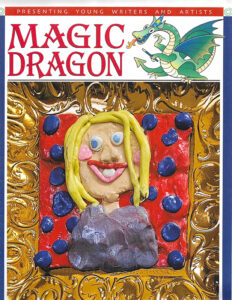 “Magic Dragon” is published four times a year by the Association for Encouragement of Children’s Creativity, a nonprofit 501(c) (3) organization.
To subscribe ($28 yearly), mail name, address and check or money order to Magic Dragon, PO Box 687, Webster, NY 14580 or go online to www.magicdragonmagazine.com and pay with credit card or Paypal.
To submit a child’s writing (story, essay, poem) send a double-spaced copy, not the original.
To submit art, send the original or a copy. If you want it returned, include a self-addressed envelope, with postage, big enough to enclose the artwork. Include a “permission to publish” form that can be downloaded from the website.
Send writing and art and permission form to the address above. To submit by email, go to the website above (writing must be a Word document, art must be a jpeg file).